Original question & working
Calibrate exponential decay · source reference
[modified 2015/YJC/Promo/9] · Question pp. 2 · Working pp. 8, 9
Open the interactive lessonThe working and teaching notes are included in the interactive lesson.
View source review notesFull original question, working & notes
Printed question
A certain radioactive substance is known to decay at a rate proportional to the mass present. A block of this substance has an initial mass of 200 grams. After 40 hours, its mass is reduced to 180 grams. Given that grams is the mass of the substance present at time hours, write down a differential equation relating and . [1]
(i) Show that . [4]
(ii) Find the half-life of the radioactive substance, that is, the time it takes for the substance to decay to half of its mass, giving your answer correct to the nearest hour. [2]
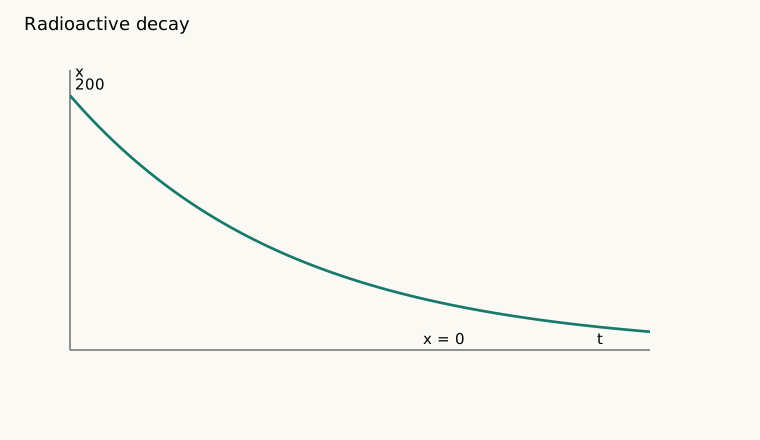
(iii) Sketch the curve that shows the mass of the block of radioactive substance over time. Hence explain what happens to the radioactive substance eventually. [2]
[modified 2015/YJC/Promo/9]
Printed working
, . ; since ; , .
At , . At , . Thus .
Let hours be the half-life. (1) and (2).
Divide (2) by (1): ; ; (nearest hours).
The radioactive substance will gradually decrease in mass but will never disintegrate completely in this continuous model.
Printed answer key
, where . (ii) 263 (to nearest hours). (iii) Native sketch below. The radioactive substance will gradually decrease in mass but will never disintegrate completely.
Teacher note 1
Given . Note the substance decays, so decreases as increases and . Usually denote a negative constant as minus a positive value.
Teacher note 2
Note is negative, so as , . Time refers to hours, so ; sketch only that part of the curve.
Diagram 10-07-decay
Mathematical review
Write , . Separation gives . Initial mass gives A=200 and , so and .
For half-life T, , so hours, or 263 hours. The graph starts at (0,200), decreases convexly, and approaches x=0 for t≥0. Under this continuous model mass remains positive at every finite time; this is a model prediction rather than a literal account of individual atoms.
Provenance
TJC JC2 2025 H2 Maths (9758) MSM. Native transcription checked against original visible question, working and sidebars. Question page(s): 2. Working page(s): 8, 9. Original records remain private for QA; this native article has no PDF or raster worksheet dependency.