Calibrate exponential decay
A certain radioactive substance is known to decay at a rate proportional to the mass present. A block of this substance has an initial mass of 200 grams. After 40 hours, its mass is reduced to 180 grams. Given that grams is the mass of the substance present at time hours, write down a differential equation relating and . mark
(i) Show that . marks
(ii) Find the half-life of the radioactive substance, that is, the time it takes for the substance to decay to half of its mass, giving your answer correct to the nearest hour. marks
(iii) Sketch the curve that shows the mass of the block of radioactive substance over time. Hence explain what happens to the radioactive substance eventually. marks
[modified 2015/YJC/Promo/9]
Solution
Modelling
A radioactive substance decays at a rate proportional to the mass present. Write down a differential equation relating (grams) and (hours).
Hint
Rate of change is proportional to , and it is a decrease.
That would model growth. Put the minus sign in front of a positive .
Answer · Differential equation
, .
Write it
Decay means , so use a minus sign with .
Separating variables
Initially 200 g; after 40 hours 180 g. Show that .
Hint
Separate: .
Use the two readings to find and .
The exponent is negative: the curve decays.
Answer · (i)
.
Separate
, so no modulus is needed.
Initial mass
.
Second reading
Take natural logs.
Result
.
Explore the idea
Half-life
Find the half-life to the nearest hour.
Hint
Solve for .
Using 100 g as the target is valid for the initial 200 g. The ratio proof shows that any starting amount halves in about 263 hours.
Answer · (ii)
hours.
Half the mass
The ratio of masses after time is independent of the starting mass.
Solve
Divide.
Long-term behaviour
Sketch the curve and explain what eventually happens.
Hint
, so .
An exponential tends to zero but never equals it.
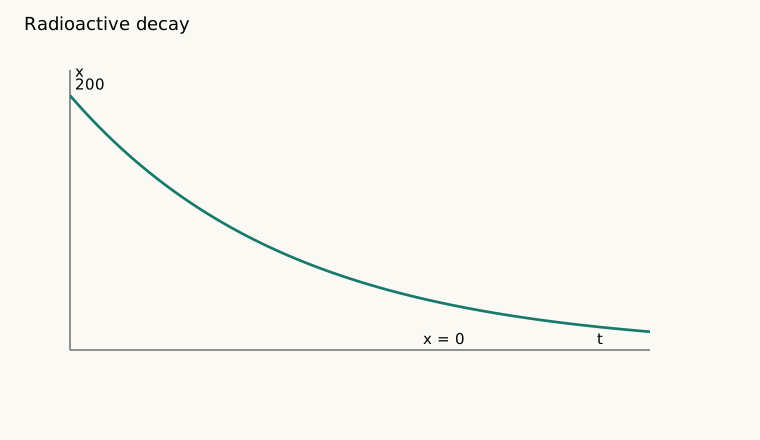
Answer · (iii)
Decays from 200 toward 0, remaining positive at every finite time.
Limit
Exponential decay. Sketch the physical time domain , starting at 200 g.
Never zero
.