Original question & working
An exponential height law makes the rod never land · source reference
[2012/HCI/I/8] · Question pp. 3 · Working pp. 13
Open the interactive lessonThe working and teaching notes are included in the interactive lesson.
View source review notesFull original question, working & notes
Printed question
Jesse leans a 6 metre rod XY in the position as shown below. At time seconds, the two ends X and Y are and metres from O respectively.
(i) State an equation relating and . [1]
As the rod slips, Jesse proposes that decreases at a rate proportional to .
(ii) Based on Jesse’s proposal, show that , where is a constant. [3]
Initially, X is 4 metres from O. Take .
(iii) Find an expression for in terms of and find the time taken for Y to be 3 metres from O from the instance Jesse lets go of the rod, giving your answer to 1 decimal place. [5]
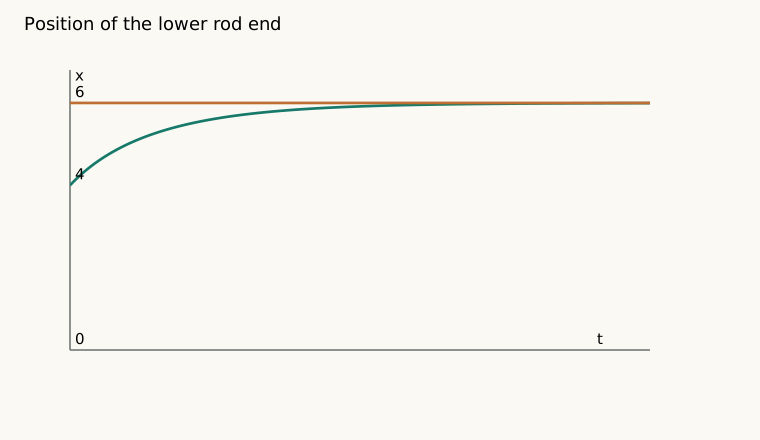
(iv) Sketch the graph of against . Hence, comment on whether Jesse’s proposed model is appropriate. Justify your answer. [3]
[2012/HCI/I/8]
Printed working
.
, . Differentiate : .
.
With , .
; since .
; , ; ; since .
At 0, : . Thus .
For , ; ; s (1 d.p.).
The source sketch starts at , approaches asymptote for . Based on Jesse’s model, will never be 6: the rod would never fall flat. Thus the model is not appropriate.
Printed answer key
(i) . (iii) ; 0.2 s. (iv) No; native sketch below.
Teacher note 1
Since decreases as increases, . Since , the constant of proportionality is negative for .
Teacher note 2
Given a DE of form , rearrange before integrating with respect to : , hence .
Teacher note 3
Note ; do not sketch any curve for .
Diagram 10-10-rod
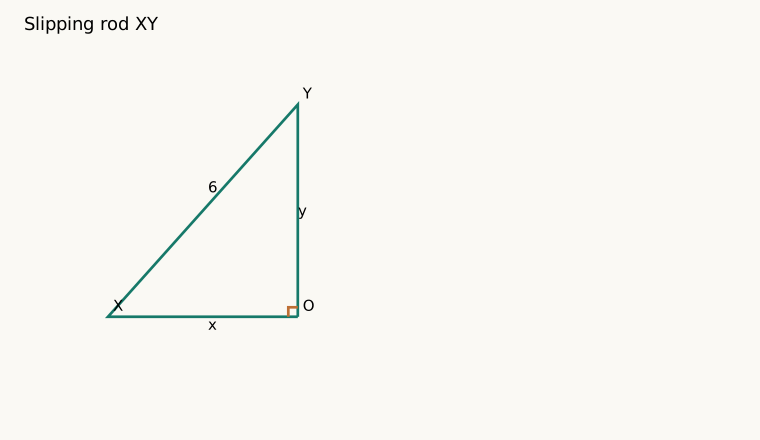
X is left of O, Y above O; right-angle square and x,y,6 labels retained.
Diagram 10-10-solution
Mathematical review
(i) . (ii) Differentiation gives , hence .
(iii) With k=2, , so . Initial x=4 gives A=20. Thus for t≥0, with . At y=3, , so , or 0.2 s.
(iv) x starts at 4, increases concavely toward the asymptote x=6. Since y never reaches zero at finite t, this model predicts the rod never lies flat, a limitation for an actual slipping rod.
Provenance
TJC JC2 2025 H2 Maths (9758) MSM. Native transcription checked against original visible question, working and sidebars. Question page(s): 3. Working page(s): 13. Original records remain private for QA; this native article has no PDF or raster worksheet dependency.