An exponential height law makes the rod never land
Jesse leans a 6 metre rod XY in the position as shown below. At time seconds, the two ends X and Y are and metres from O respectively.
(i) State an equation relating and . mark
As the rod slips, Jesse proposes that decreases at a rate proportional to .
(ii) Based on Jesse’s proposal, show that , where is a constant. marks
Initially, X is 4 metres from O. Take .
(iii) Find an expression for in terms of and find the time taken for Y to be 3 metres from O from the instance Jesse lets go of the rod, giving your answer to 1 decimal place. marks
(iv) Sketch the graph of against . Hence, comment on whether Jesse’s proposed model is appropriate. Justify your answer. marks
[2012/HCI/I/8]
Solution
Pythagoras
State an equation relating and for a 6 m rod.
Hint
Right-angled triangle with hypotenuse 6.
The rod is the hypotenuse, not the sum of two sides.
Answer · (i)
.
Pythagoras
.
Related rates
If , show .
Hint
Differentiate with respect to .
decreases, so with .
Answer · (ii)
.
Differentiate
Chain rule.
Substitute
.
Eliminate
.
Separation of variables
With and initially, find in terms of and the time for to reach 3 m.
Hint
Separate: .
means .
here, so needs no modulus.
Answer · (iii)
; at , s.
Separate
.
Solve for
.
Initial value.
Time for
.
Explore the idea
Evaluating the model
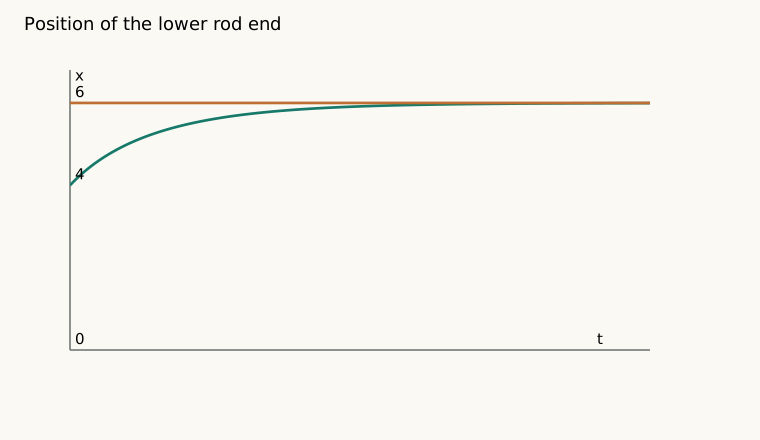
Sketch against and comment on whether the model is appropriate.
Hint
As , .
The long-term behaviour contradicts the physical situation.
Answer · (iv)
Rises concavely from toward asymptote ; inappropriate for a rod expected to fall flat in finite time.
Limit
On the physical time domain , starts at 4 and increases towards 6. would mean the rod lies flat on the ground.
Never reached
.