Original question & working
Keep population units consistent · source reference
[2019/RVHS/Prelim/I/10] · Question pp. 4 · Working pp. 14, 15
Open the interactive lessonThe working and teaching notes are included in the interactive lesson.
View source review notesFull original question, working & notes
Printed question
Since the 1990s, a group of scientists has started conservation work to prevent the extinction of a rare species of flying fox in the wild Western Australia forests. The number of such species, in thousands, observed in the forests at time years after the start of the conservation is denoted by . It is known that the death rate of the flying foxes is proportional to the number of flying foxes present and that the birth rate of the flying foxes has been maintained constant at 2000 per year. There were only 1000 flying foxes in the forests at the start of the conservation and the rate of increase of the number of flying foxes was 1500 per year when there were 3000 flying foxes.
(i) Form a differential equation relating and show that it can be reduced to . [2]
(ii) Solve the differential equation to find in terms of . [5]
(iii) Deduce the minimum number of years in integer, needed for the number of flying foxes to exceed 6000. [2]
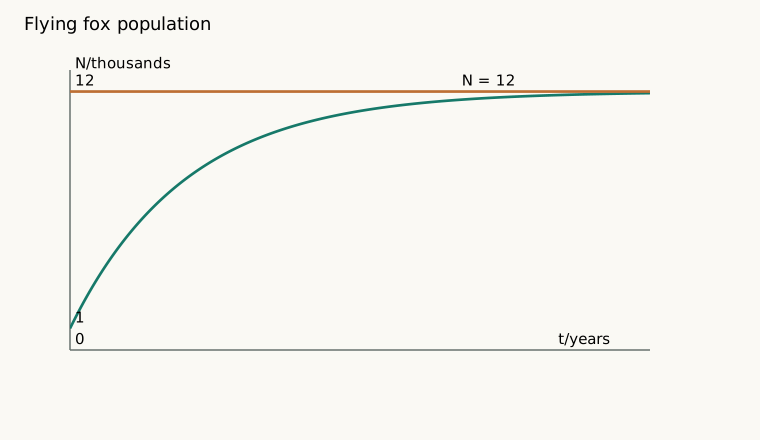
(iv) Sketch a graph to show how the number of flying foxes in the forests varies with time and suggest the long term behavior of the flying fox population. [3]
(v) Suggest a possible limitation of the model in part (i). [1]
[2019/RVHS/Prelim/I/10]
Printed working
, .
At , : ; .
; ; .
; , .
At 0, : ; .
Printed threshold calculation: . Minimum integer is 4 years to first exceed 6000.
As , , so . Long-term population approaches 12 thousand.
Possible limitations: external factors such as (i) sudden natural disasters affecting population, (ii) increased hunting over the years, (iii) adverse climate change affecting habitat.
Printed answer key
(i) , . (ii) . (iii) 4 years. (iv) Approaches 12 thousand; native sketch below.
Teacher note 1
Note number of flying foxes is in thousands.
Teacher note 2
Given . Integrate .
Need to put in the modulus sign when integration results in a logarithm, since its argument may be negative. In removing the modulus sign, remember to put in “”. Here may be negative. At start of conservation ; 1000 flying foxes means .
Diagram 10-11-population
Mathematical review
(i) . From , , so .
(ii) Integrating gives . N(0)=1 yields .
(iii) gives years, so the first integer year is 4.
(iv) The graph starts at (0,1), increases concavely and approaches N=12, representing 12000 flying foxes. (v) Constant births and proportional deaths ignore environmental change, habitat limits and unexpected mortality events; one such reason suffices.
Provenance
TJC JC2 2025 H2 Maths (9758) MSM. Native transcription checked against original visible question, working and sidebars. Question page(s): 4. Working page(s): 14, 15. Original records remain private for QA; this native article has no PDF or raster worksheet dependency.