Keep population units consistent
Since the 1990s, a group of scientists has started conservation work to prevent the extinction of a rare species of flying fox in the wild Western Australia forests. The number of such species, in thousands, observed in the forests at time years after the start of the conservation is denoted by . It is known that the death rate of the flying foxes is proportional to the number of flying foxes present and that the birth rate of the flying foxes has been maintained constant at 2000 per year. There were only 1000 flying foxes in the forests at the start of the conservation and the rate of increase of the number of flying foxes was 1500 per year when there were 3000 flying foxes.
(i) Form a differential equation relating and show that it can be reduced to . marks
(ii) Solve the differential equation to find in terms of . marks
(iii) Deduce the minimum number of years in integer, needed for the number of flying foxes to exceed 6000. marks
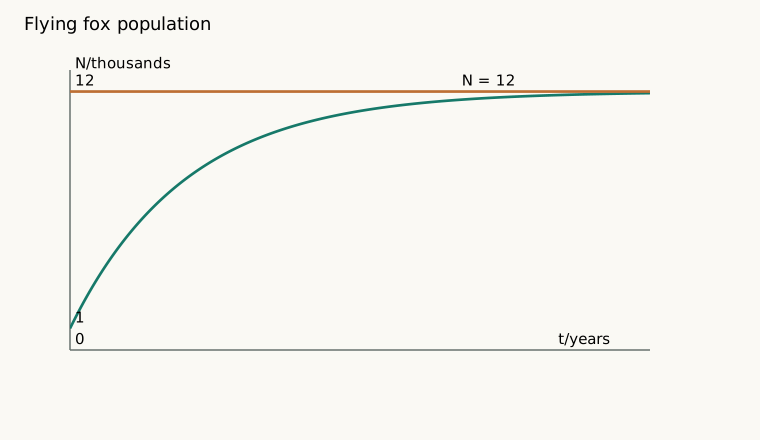
(iv) Sketch a graph to show how the number of flying foxes in the forests varies with time and suggest the long term behavior of the flying fox population. marks
(v) Suggest a possible limitation of the model in part (i). mark
[2019/RVHS/Prelim/I/10]
Solution
Forming the equation
Form a differential equation and show it reduces to .
Hint
.
Use , to find .
is in thousands: use 2, 1.5 and 3.
Answer · (i)
.
Equation
Births 2 (thousand per year); deaths .
Find
thousand.
Result
Multiply by 6.
Solving
Solve for in terms of , given at .
Hint
Separate and integrate, with a modulus.
Use .
could be negative in general; goes into .
Answer · (ii)
(thousands).
Separate
Integrate.
Solve
.
Initially means ; 1000 flying foxes is thousand, so .
Result
Explore the idea
First integer year
Deduce the least whole number of years for to exceed 6.
Hint
Solve .
'Minimum number of years in integer' means round up to 4.
Answer · (iii)
years.
Inequality
Take logs; dividing by a negative flips the inequality at the right step.
Integer
The first whole year after 3.64.
Sketch and long-term behaviour
Sketch against and describe the long-term behaviour.
Hint
Starts at , increasing, concave, with asymptote .
is an asymptote, not a value reached.
Answer · (iv)
Rises concavely from 1 toward 12 thousand.
Features
For , starts at and increases concavely towards , or 12000 flying foxes.
Limitation
Suggest a limitation of the model.
Hint
Think about assumptions: constant births and proportional deaths.
Say which assumption fails.
Answer · (v)
Constant births/proportional deaths ignore changing habitat or mortality.
A limitation
The model ignores habitat limits, disasters, hunting or climate change.