Original question & working
Area identities and a cross-product degeneracy · source reference
[2018/DHS/Prelim/II/1] · Question pp. 2 · Working pp. 7
Open the interactive lessonThe working and teaching notes are included in the interactive lesson.
Printed source relation needs a qualification for the valid case 2b+3d=0; original answer is preserved in the source panel.
Full original question, working & notes
Question
Relative to O, A and B have position vectors a,b, nonzero and nonparallel.
(i) State the shortest distance from B to the line through O,A. [1]
(ii) Given , state the geometrical meaning of and show . [2]
(iii) Given , find a linear relationship between a,b,d. [2]
[2018/DHS/Prelim/II/1]
Source working
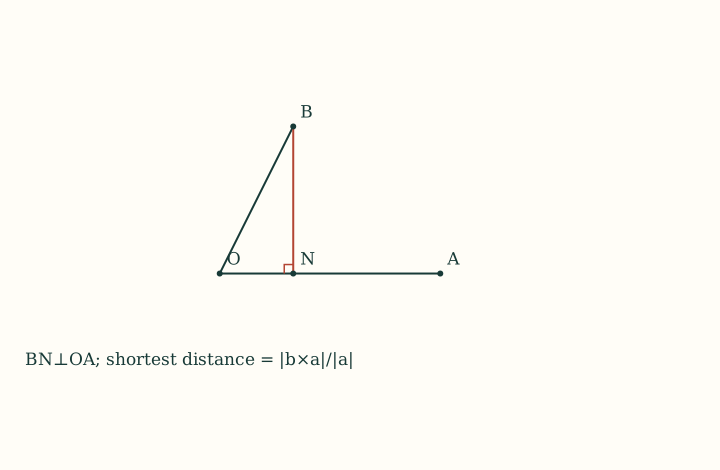
(i) Shortest distance or .
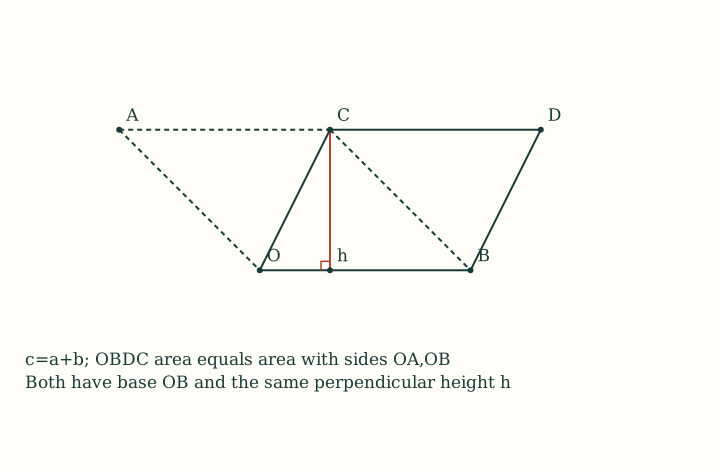
(ii) is the area of a parallelogram with sides OB and OC.
The parallelograms with sides OB,OC and OA,OB have the same base and vertical height.
(iii)
Printed conclusion: a is parallel to , so , .
Teacher notes
The shortest distance is perpendicular BN from B to OA.
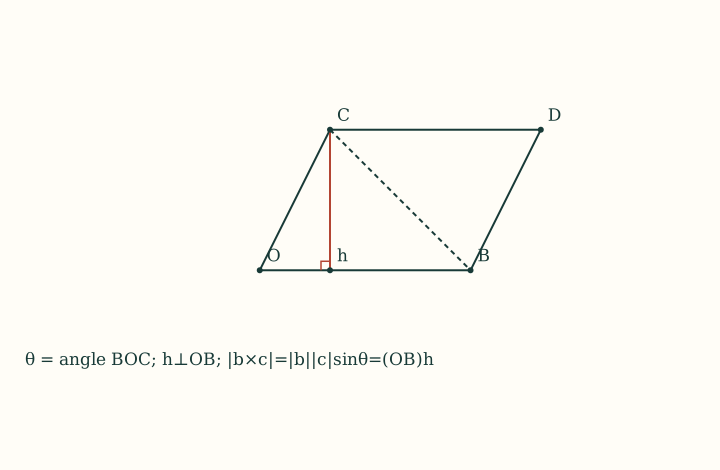
For parallelogram OBDC,
For (iii), the margin writes
where θ is between a and , and is perpendicular to both. It concludes , or , so parallel.
Qualification of printed relationship
The source omits , where that angle is undefined and a cannot equal a scalar times the zero vector. The inclusive relationship is for real , allowing .
Native diagrams
The distance panel has O,N,A on a line, B above N and right angle at N. The area panel shows A,C,D collinear, O,B on the parallel base, dotted AC extension and AB/CB diagonals, red h and its right angle; a separate margin parallelogram OBDC labels θ between OB,OC and the same height h.
Printed answer key
(i) or ; (ii) area of a parallelogram with sides OB and OC; (iii) , . See the qualification above for the omitted zero-vector case.
Provenance
2025 TJC H2 Math (9758) JC2 MSM: VECTORS. Question document pages 2; solution document pages 7. Original page numbers are retained as text metadata.