Porisma

Original question & working

A wardrobe model from lines and planes · source reference

[2023/TMJC/Prelim/I/9] · Question pp. 6 · Working pp. 30, 31, 32, 33

Open the interactive lesson

The working and teaching notes are included in the interactive lesson.

View source review notes
Full original question, working & notes

Printed question

A home interior designer is looking to design a pull-down wardrobe lift. To test his concept, the designer built a small-scale model of it, in which points (x,y,z)(x,y,z) are defined relative to a corner of the model at O(0,0,0)O(0,0,0). The rods used in the model can be modelled by equations of straight lines.

The main rod can be modelled by the line l1l_1 with equation r=(5,−5,8)+λ(1,1,0)\mathbf r=(5,-5,8)+\lambda(1,1,0), λ∈R\lambda\in\mathbb R. Another rod, line l2l_2, passes through the points A(5,−5,8)A(5,-5,8) and B(8,−4,3)B(8,-4,3).

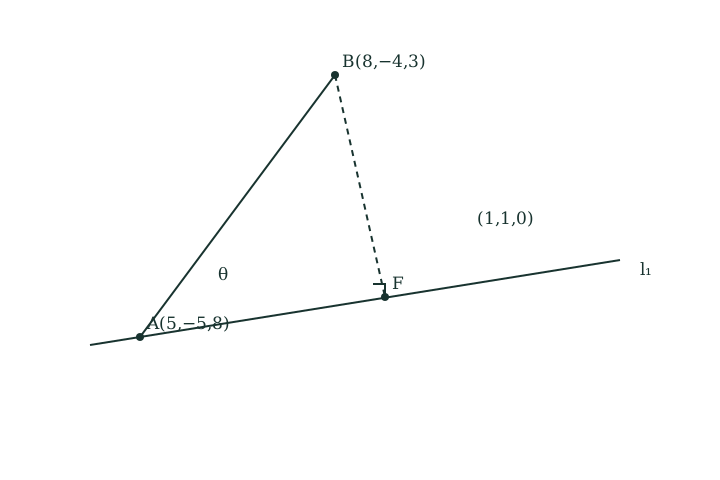
(a) A supporting wire connects BB to a point FF on l1l_1 such that BFBF is perpendicular to l1l_1. Find the position vector of FF. [3]

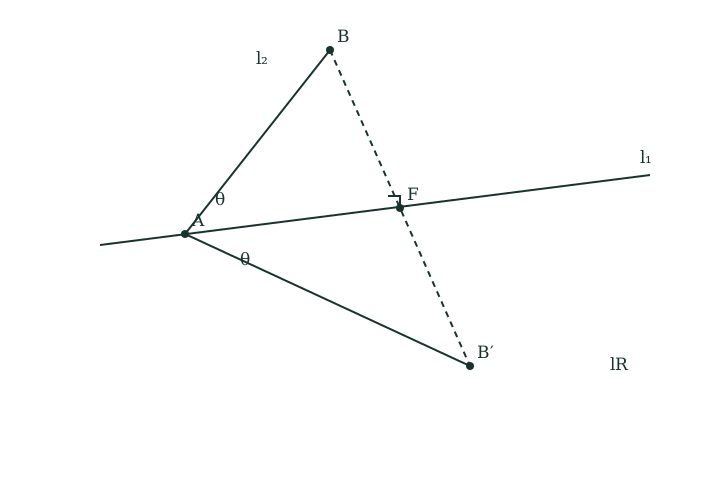
(b) A retractable rod, line lRl_R, is placed such that it can be modelled by reflecting l2l_2 about l1l_1. Find a vector equation of lRl_R. [3]

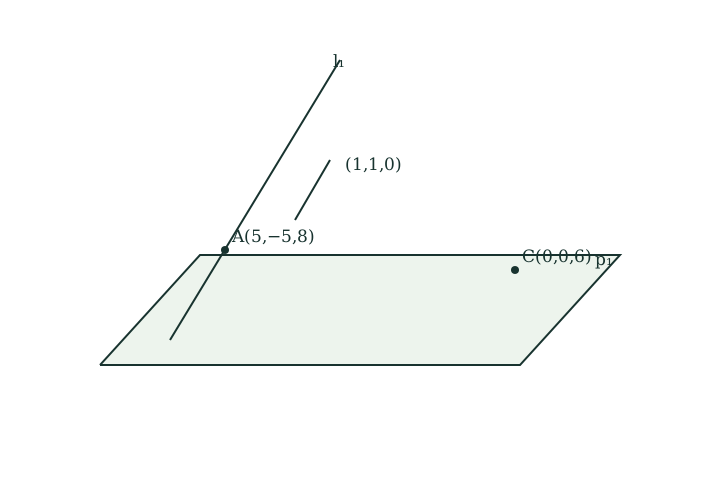
The panels of the small-scale model can be modelled by equations of planes. The main panel, plane p1p_1, contains the main rod l1l_1 and an attachment point C(0,0,6)C(0,0,6). A side panel, plane p2p_2, can be represented by the equation p2:−17x−37y+4z=24p_2:-17x-37y+4z=24.

(c) Show that p1p_1 can be represented by the cartesian equation −x+y+5z=30-x+y+5z=30. [3]

(d) A structural rod, line lSl_S, needs to be placed at the intersection between p1,p2p_1,p_2. Find a vector equation of lSl_S. [2]

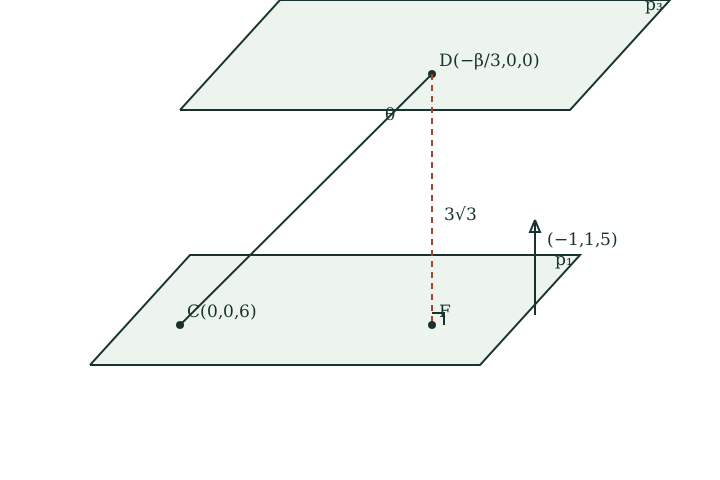
(e) A decorative plank, plane p3p_3, has equation p3:−3x+αy+15z=βp_3:-3x+\alpha y+15z=\beta, where α,β∈R\alpha,\beta\in\mathbb R. If the distance between p1,p3p_1,p_3 is exactly 333\sqrt3 units, find the possible values of α,β\alpha,\beta. [3]

[2023/TMJC/Prelim/I/9]

Printed working

(a) OA→=(5,−5,8)\overrightarrow{OA}=(5,-5,8), OB→=(8,−4,3)\overrightarrow{OB}=(8,-4,3).

Method 1: Scalar product = 0

Since FF lies on l1l_1, OF→=(5,−5,8)+λ(1,1,0)\overrightarrow{OF}=(5,-5,8)+\lambda(1,1,0) for some λ∈R\lambda\in\mathbb R.

Since BF⊥l1BF\perp l_1, [(5,−5,8)+λ(1,1,0)−(8,−4,3)]⋅(1,1,0)=0[(5,-5,8)+\lambda(1,1,0)-(8,-4,3)]\cdot(1,1,0)=0.

[(−3+λ,−1+λ,5)]⋅(1,1,0)=0⇒−3+λ−1+λ=0⇒λ=2[(-3+\lambda,-1+\lambda,5)]\cdot(1,1,0)=0\Rightarrow-3+\lambda-1+\lambda=0\Rightarrow\lambda=2.

∴OF→=(5,−5,8)+2(1,1,0)=(7,−3,8)\therefore\overrightarrow{OF}=(5,-5,8)+2(1,1,0)=(7,-3,8).

Method 2: Vector Projection

AB→=(8,−4,3)−(5,−5,8)=(3,1,−5)\overrightarrow{AB}=(8,-4,3)-(5,-5,8)=(3,1,-5).

AF→=AB→⋅(1,1,0)∣(1,1,0)∣(1,1,0)∣(1,1,0)∣=42(1,1,0)=2(1,1,0)=(2,2,0)\overrightarrow{AF}=\frac{\overrightarrow{AB}\cdot(1,1,0)}{|(1,1,0)|}\frac{(1,1,0)}{|(1,1,0)|}=\frac42(1,1,0)=2(1,1,0)=(2,2,0).

OF→=OA→+AF→=(5,−5,8)+(2,2,0)=(7,−3,8)\overrightarrow{OF}=\overrightarrow{OA}+\overrightarrow{AF}=(5,-5,8)+(2,2,0)=(7,-3,8).

(b) Method 1: Midpoint theorem (w.r.t. point A)

AF→=AB→+AB′→2\overrightarrow{AF}=\frac{\overrightarrow{AB}+\overrightarrow{AB'}}2, where B′B' is pt of reflection of BB about l1l_1.

AB′→=2AF→−AB→=2[(7,−3,8)−(5,−5,8)]−[(8,−4,3)−(5,−5,8)]=(1,3,5)\overrightarrow{AB'}=2\overrightarrow{AF}-\overrightarrow{AB}=2[(7,-3,8)-(5,-5,8)]-[(8,-4,3)-(5,-5,8)]=(1,3,5).

lR:r=(5,−5,8)+μ(1,3,5)l_R:\mathbf r=(5,-5,8)+\mu(1,3,5), μ∈R\mu\in\mathbb R.

Method 2: Midpoint theorem (w.r.t. point O)

OF→=OB→+OB′→2\overrightarrow{OF}=\frac{\overrightarrow{OB}+\overrightarrow{OB'}}2.

OB′→=2OF→−OB→=2(7,−3,8)−(8,−4,3)=(6,−2,13)\overrightarrow{OB'}=2\overrightarrow{OF}-\overrightarrow{OB}=2(7,-3,8)-(8,-4,3)=(6,-2,13).

AB′→=(6,−2,13)−(5,−5,8)=(1,3,5)\overrightarrow{AB'}=(6,-2,13)-(5,-5,8)=(1,3,5).

lR:r=(5,−5,8)+μ(1,3,5)l_R:\mathbf r=(5,-5,8)+\mu(1,3,5), μ∈R\mu\in\mathbb R.

(c) CA→=(5,−5,8)−(0,0,6)=(5,−5,2)\overrightarrow{CA}=(5,-5,8)-(0,0,6)=(5,-5,2) or CF→=(7,−3,8)−(0,0,6)=(7,−3,2)\overrightarrow{CF}=(7,-3,8)-(0,0,6)=(7,-3,2).

n1=(5,−5,2)×(1,1,0)=((−5)(0)−(2)(1),(2)(1)−(5)(0),(5)(1)−(−5)(1))=(−2,2,10)=2(−1,1,5)\mathbf n_1=(5,-5,2)\times(1,1,0)=((-5)(0)-(2)(1),(2)(1)-(5)(0),(5)(1)-(-5)(1))=(-2,2,10)=2(-1,1,5).

r⋅(−1,1,5)=(0,0,6)⋅(−1,1,5)=30\mathbf r\cdot(-1,1,5)=(0,0,6)\cdot(-1,1,5)=30.

p1:−x+y+5z=30p_1:-x+y+5z=30 (Shown).

(d) Method 1 (using GC)

p1:−x+y+5z=30p_1:-x+y+5z=30 — (1); p2:−17x−37y+4z=24p_2:-17x-37y+4z=24 — (2).

Using GC, x=−21+72tx=-21+\frac72t, y=9−32ty=9-\frac32t, z=tz=t.

lS:r=(−21,9,0)+α(7,−3,2)l_S:\mathbf r=(-21,9,0)+\alpha(7,-3,2), α=t2∈R\alpha=\frac t2\in\mathbb R.

Method 2 (not recommended for this question)

Direction vector of line of intersection

=(−1,1,5)×(−17,−37,4)=(189,−81,54)=27(7,−3,2)=(-1,1,5)\times(-17,-37,4)=(189,-81,54)=27(7,-3,2).

Check that C(0,0,6)C(0,0,6) lies on both p1,p2p_1,p_2.

lS:r=(0,0,6)+α(7,−3,2)l_S:\mathbf r=(0,0,6)+\alpha(7,-3,2), α∈R\alpha\in\mathbb R.

(e) p1:−x+y+5z=30p_1:-x+y+5z=30; p3:−3x+αy+15z=βp_3:-3x+\alpha y+15z=\beta.

p1:r⋅(−1,1,5)=30p_1:\mathbf r\cdot(-1,1,5)=30; p3:r⋅(−3,α,15)=βp_3:\mathbf r\cdot(-3,\alpha,15)=\beta.

Since p1∥p3p_1\parallel p_3, (−1,1,5)=k(−3,α,15)(-1,1,5)=k(-3,\alpha,15), k=13,α=3k=\frac13,\alpha=3.

Method 1: Length of Projection

Let a point on p3p_3 be DD, OD→=(−β/3,0,0)\overrightarrow{OD}=(-\beta/3,0,0).

CD→=(−β/3,0,0)−(0,0,6)=(−β/3,0,−6)\overrightarrow{CD}=(-\beta/3,0,0)-(0,0,6)=(-\beta/3,0,-6).

Length of projection =∣(−β/3,0,−6)⋅(−1,1,5)∣∣(−1,1,5)∣=33=\frac{|(-\beta/3,0,-6)\cdot(-1,1,5)|}{|(-1,1,5)|}=3\sqrt3.

∣β3−30∣=33(27)|\frac\beta3-30|=3\sqrt3(\sqrt{27}).

β3−30=±27\frac\beta3-30=\pm27.

β3=57\frac\beta3=57 or β3=3\frac\beta3=3.

β=171\beta=171 or β=9\beta=9.

Method 2: Distance between planes

p3:r⋅(−3,3,15)=β⇒p3:r⋅(−1,1,5)=β3p_3:\mathbf r\cdot(-3,3,15)=\beta\Rightarrow p_3:\mathbf r\cdot(-1,1,5)=\frac\beta3 and p1:r⋅(−1,1,5)=30p_1:\mathbf r\cdot(-1,1,5)=30.

Distance between p1,p3p_1,p_3 is exactly 333\sqrt3 units.

∣30−β/3∣(−1)2+12+52=33\frac{|30-\beta/3|}{\sqrt{(-1)^2+1^2+5^2}}=3\sqrt3.

∣30−β3∣=27⇒β3=30±27∴β=9|30-\frac\beta3|=27\Rightarrow\frac\beta3=30\pm27\therefore\beta=9 or 171171.

Native source teaching diagram, Q19 projection Native source teaching diagram, Q19 reflection Native source teaching diagram, Q19 panel Native source teaching diagram, Q19 distance

Teacher notes

For vector projection, the 2 vectors bounding the angle θ\theta must both be directed away from pt AA (AB→,AF→\overrightarrow{AB},\overrightarrow{AF}) or both be directed towards pt AA (BA→,FA→\overrightarrow{BA},\overrightarrow{FA}).

p1∥p3⇒n1∥n3p_1\parallel p_3\Rightarrow\mathbf n_1\parallel\mathbf n_3, where n1,n3\mathbf n_1,\mathbf n_3 are normals of p1,p3p_1,p_3.

Length of projection =DF=CDcos⁡θ=∣CD→⋅n^1∣=DF=CD\cos\theta=|\overrightarrow{CD}\cdot\hat{\mathbf n}_1|.

Make the 2 parallel normal vectors of the 2 planes the same, i.e. (−1,1,5)(-1,1,5).

Note ∣(−1,1,5)∣=(−1)2+12+52|(-1,1,5)|=\sqrt{(-1)^2+1^2+5^2}.

Printed answer key

(a) (7,−3,8)(7,-3,8). (b) lR:r=(5,−5,8)+μ(1,3,5)l_R:\mathbf r=(5,-5,8)+\mu(1,3,5), μ∈R\mu\in\mathbb R. (d) lS:r=(−21,9,0)+α(7,−3,2)l_S:\mathbf r=(-21,9,0)+\alpha(7,-3,2), α∈R\alpha\in\mathbb R. (e) α=3,β=9\alpha=3,\beta=9 or β=171\beta=171. Short key omits (c).

Editorial qualification

The scalar-product question does not explicitly state parallel planes, but a positive shortest plane-to-plane distance forces parallelism. The source’s normal comparison is valid under this distance interpretation.

Source provenance

2025 TJC H2 Math (9758) JC2 MSM: VECTORS. Question booklet PDF pages 4–12 (printed 80–88); solution booklet PDF pages 17–44. Column vectors are typeset as ordered coordinate triples here; the entries, products, intermediate equations and original parameter/domain restrictions are retained.