Original question & working
A conditional limit in a two-cycle map · source reference
[2011/CJC/Prelim/I/2] · Question pp. 3 · Working pp. 9, 10
Open the interactive lessonThe working and teaching notes are included in the interactive lesson.
The printed question assumes convergence only in (i). Do not infer convergence of every sequence from the one-step inequalities.
Full original question, working & notes
Printed question
A sequence of positive real numbers satisfies
(i) Given convergence to , find exactly. [3]
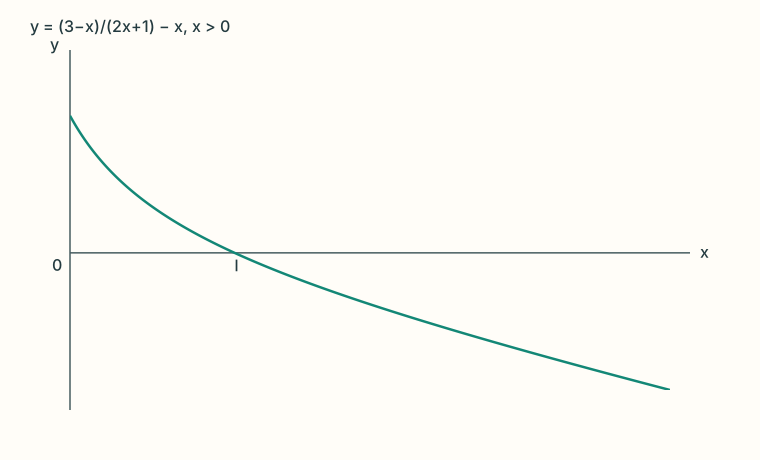
(ii) Using a sketch of and considering , prove if , and if . [3]
Printed working
(i) As , .
Since , .
(ii) .
From the sketch, if , , hence and .
If , , hence and .
Source diagrams redrawn
Printed answer key
(i)
Mathematical review and qualifications
(i) gives . Positivity selects . A zero limit cannot satisfy the equation.
(ii) . On the numerator strictly decreases, is positive before , zero at and negative after , giving the required inequalities. The increment graph starts at 3, crosses once at and becomes negative.
Qualification: direct composition gives wherever defined. Thus a nonconstant admissible sequence alternates between two values and does not converge; the premise in (i) forces the constant sequence . This preserves the printed source conditional conditional wording.
The printed question assumes convergence only in (i). Do not infer convergence of every sequence from the one-step inequalities.
Provenance
2025 TJC H2 Math (9758) JC2 MSM: RECURRENCE RELATIONS. [2011/CJC/Prelim/I/2] Question PDF pages 3; solution PDF pages 9, 10. The original files remain private QA records outside this native content.