A conditional limit in a two-cycle map
A sequence of positive real numbers satisfies
(i) Given convergence to , find exactly. marks
(ii) Using a sketch of and considering , prove if , and if . marks
[2011/CJC/Prelim/I/2]
Solution
Exact limit
Positive satisfy . Given that the sequence converges to , find exactly.
Hint
Replace both terms by and clear the denominator.
Use the quadratic formula and choose the positive root.
Answer · (i)
.
The convergence premise forces the constant sequence: F∘F is the identity, so nonconstant admissible sequences form two-cycles.
Limit equation
Multiply by .
Quadratic formula
The discriminant is .
Choose the positive root
All terms are positive, so the limit cannot be negative.
Explore the idea
Increment sign from a sketch
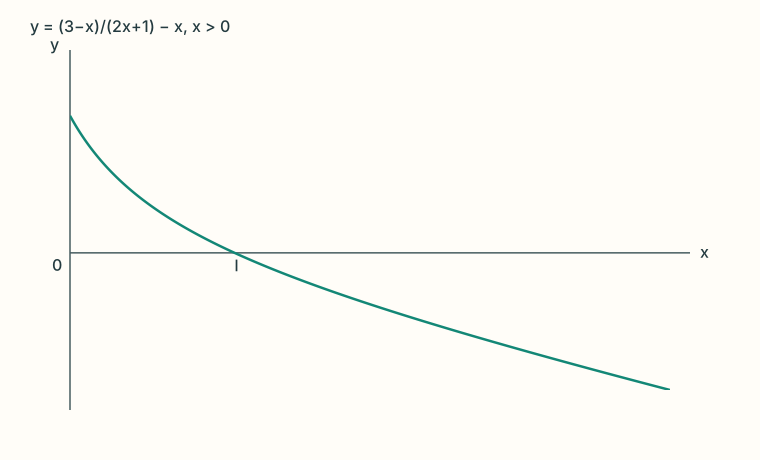
Using a sketch of and considering , prove if , and if .
Hint
Identify the graph's height with .
Read its sign from the sketch: positive before , negative after.
Increase-below and decrease-above are one-step facts. Since here, a sequence that starts anywhere other than never converges.
Answer · (ii)
: positive on , zero at , negative for .
This one-step comparison does not imply convergence.
The graph is the increment
The numerator is a downward-opening quadratic in , and the denominator is positive for .
Read the signs from the sketch
The graph starts at height when , crosses the axis once at , and stays below it afterwards.
Translate to the terms
These are statements about a single step.
Explore the idea
A true step is not a trend
The two printed inequalities describe each step correctly. Because , a nonconstant admissible sequence alternates between two values, so the premise of convergence in (i) forces for every .