Original question & working
Root midpoint and a parallelogram · source reference
[2022/VJC/Promo/9] · Question pp. 2 · Working pp. 7, 8
Open the interactive lessonThe working and teaching notes are included in the interactive lesson.
View source review notesFull original question, working & notes
Question
The complex number satisfies , where is a complex constant.
(i) Given are two distinct roots, show . [2]
It is given and .
(ii) Find in the form , with real. Leave exact. [3]
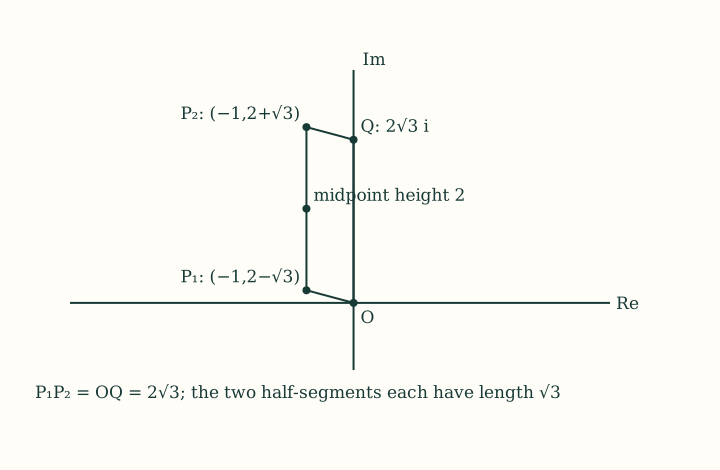
(iii) On an Argand diagram indicate clearly representing respectively. [2]
(iv) O and Q represent 0 and respectively. is a parallelogram. Using (iii), find . [2]
[2022/VJC/Promo/9]
Source working
Printed working
(i) . Comparing the coefficient of , , hence .
Alternative quadratic-formula proof:
Adding the two expressions cancels the radicals:
The printed label says “(1)−(2)” above this addition; this is a label typo, not the operation used.
(ii)
Thus , .
(iii) The native diagram labels O, Re(z), Im(z), , , , , and . Its two marked half-segments between and show the midpoint at height 2.
(iv) and . Hence .
Teacher note
Q lies on the imaginary axis since is a parallelogram.
Printed answer key
(ii) . (iv) .
Native diagrams
Provenance
2025 TJC H2 Math (9758) JC2 MSM: COMPLEX NUMBERS. Question pages 2; solution pages 7, 8. These are original document page numbers, retained as text metadata.