Root midpoint and a parallelogram
The complex number satisfies , where is a complex constant.
(i) Given are two distinct roots, show . marks
It is given and .
(ii) Find in the form , with real. Leave exact. marks
(iii) On an Argand diagram indicate clearly representing respectively. marks
(iv) O and Q represent 0 and respectively. is a parallelogram. Using (iii), find . marks
[2022/VJC/Promo/9]
Solution
Sum of roots
has distinct roots . Show that .
Hint
Write the equation as and use the sum of roots.
Answer · (i)
.
Sum of roots
Expand and compare the coefficient of . The roots add to , regardless of .
Halve it
The midpoint of the segment joining the two roots is fixed, whatever is.
Alternative: add the quadratic-formula roots
Adding the two roots cancels the square-root terms. Halving again gives . The source label saying to subtract is a slip; this proof adds the roots.
Explore the idea
Solve with a complex discriminant
With and , find in the form with exact .
Hint
Compute the discriminant of .
Use .
Answer · (ii)
, .
Discriminant
with and . It is real and negative.
Roots
, and half of it is .
Order by imaginary part
selects the minus sign for .
Plot the roots
On an Argand diagram indicate representing .
Hint
Read off the coordinates and plot them.
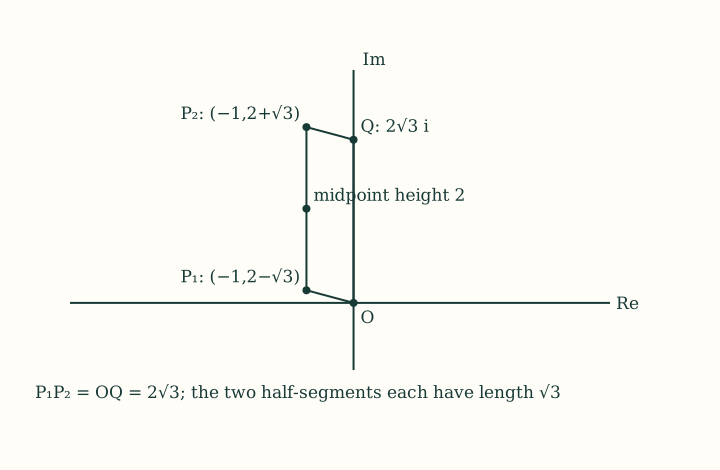
Answer · (iii)
, .
Coordinates
Both points lie on the vertical line , symmetric about .
Explore the idea
Parallelogram on the Argand diagram
and represent and , and is a parallelogram. Find .
Hint
Opposite sides of a parallelogram are equal vectors: .
is opposite to , not to . Check the vertex order.
Answer · (iv)
.
Equal opposite sides
In , is parallel and equal to .
Compute
The real parts cancel.
Check with diagonals
The diagonals and bisect each other, so .
Explore the idea
Sums fix the centre
The sum of the roots depends only on the coefficient of . Roots then spread out symmetrically about half that sum.