Original question & working
Five points from one polar vector · source reference
[modified 2019/NJC/Prelim/I/1] · Question pp. 3 · Working pp. 18
Open the interactive lessonThe working and teaching notes are included in the interactive lesson.
View source review notesFull original question, working & notes
Question
has modulus and argument , with and . satisfies and .
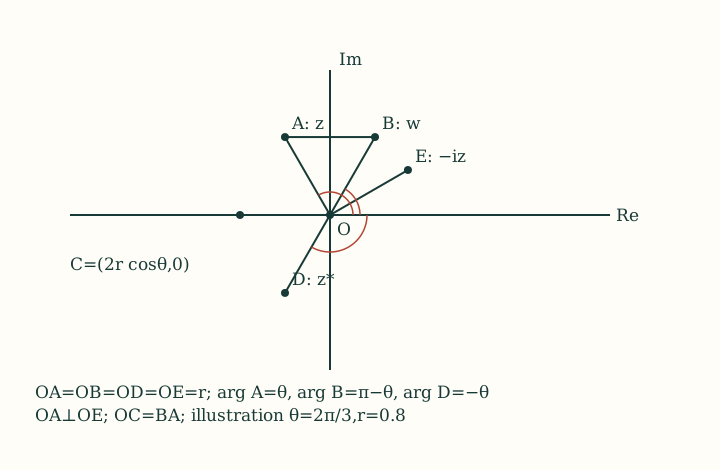
A, B, C, D and E represent respectively, where is the conjugate of . On a single Argand diagram illustrate all five points. [5]
[modified 2019/NJC/Prelim/I/1]
Source working
Printed working and teacher notes
, ; OA and OB are equally inclined to the real axis.
is represented by or , where . Since , BA is parallel to the real axis. C therefore lies on the real axis.
E is A rotated clockwise through about the origin.
All diagram labels
Re, Im, O, A, B, C, D, E; radius on OA, OB, OD and OE; angles , , ; right angle between OA and OE; .
Native coordinates clarify the diagram without changing its content:
Printed answer key
No separate short-key entry is printed; see the complete working diagram.
Native diagrams
Provenance
2025 TJC H2 Math (9758) JC2 MSM: COMPLEX NUMBERS. Question pages 3; solution pages 18. These are original document page numbers, retained as text metadata.