Five points from one polar vector
has modulus and argument , with and . satisfies and .
A, B, C, D and E represent respectively, where is the conjugate of . On a single Argand diagram illustrate all five points. marks
[modified 2019/NJC/Prelim/I/1]
Solution
Reflect, rotate and subtract
has modulus and argument , with and . Also and . Illustrate representing , , , , .
Hint
Write with .
Find each point from and .
Mark the angles and .
. The imaginary parts cancel, so is on the real axis.
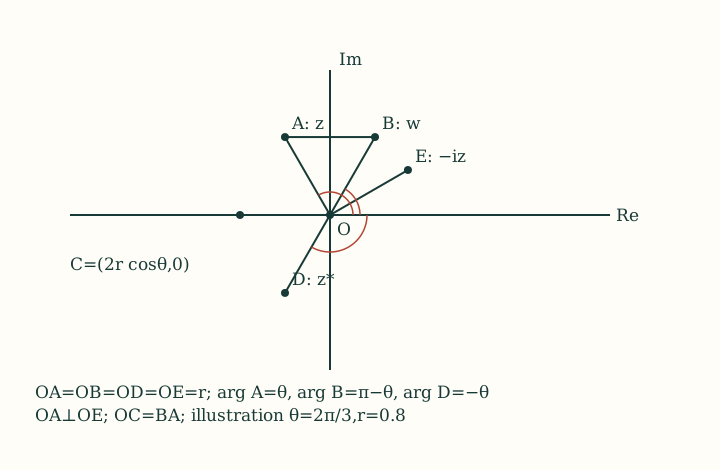
Answer · Plot A, B, C, D, E
With , : .
, ; plot represents this family.
The point
is in quadrant II, at distance from the origin.
The point
Same height, opposite real part: is the reflection of in the imaginary axis.
, and
is real and negative. Equal radii OA and OB make equal angles with the real axis, so is horizontal and equals . reflects in the real axis. Multiplying by turns through , giving .
Distances
Only has a different modulus: .
Explore the idea
Describe a family, not a single picture
A parameter range gives a family of diagrams. State the signs and relationships that all of them share.