Map three points through three transformations
The diagram above shows the graph of .
On separate diagrams, sketch the graphs of
(i) , marks
(ii) , marks
(iii) . marks
showing in each case, the coordinates of the points corresponding to and the equations of the asymptotes.
[2010/SRJC/Prelim/II/3]
Solution
Scaling and translation
Sketch the graph of , showing the coordinates of the points corresponding to , and and the equations of the asymptotes.
Hint
Which operation acts on first: the “2×” or the “+1”?
Apply the same two operations to the -coordinate of every point, and to the equation of every horizontal asymptote.
What happens to a vertical asymptote when only changes?
means double first, then add 1. Adding 1 first would give .
Horizontal asymptotes move with the graph: .
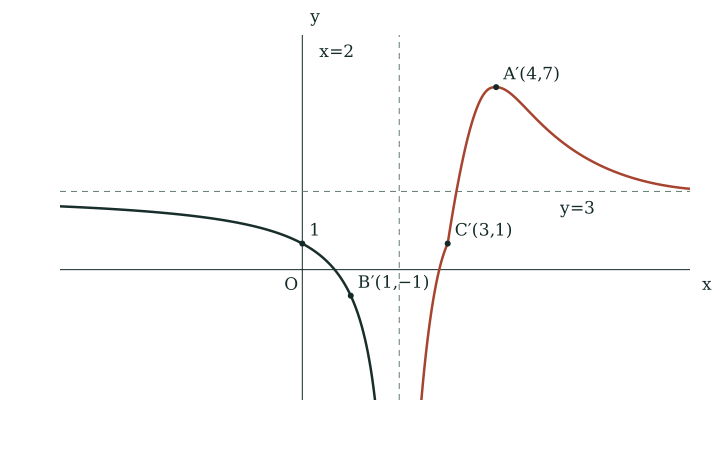
Answer · (i)
; asymptotes .
Scale parallel to the -axis
Every -coordinate is doubled. , , . The asymptote becomes .
Translate 1 unit up
Add 1 to every -coordinate: , , . The asymptote becomes .
Check what did not move
Neither step touches , so the vertical asymptote stays at , and the -coordinates are unchanged.
Explore the idea
Modulus of the input
Sketch the graph of , showing the coordinates of the points corresponding to , and and the equations of the asymptotes.
Hint
only ever feeds non-negative numbers into . What does that say about the graph for ?
Keep the part of the graph with , then mirror it in the -axis.
Each asymptote with gets a mirror image.
throws away the left-hand part of . Do not draw both the left half of and its reflection.
The asymptote is reflected to . Both belong on the sketch.
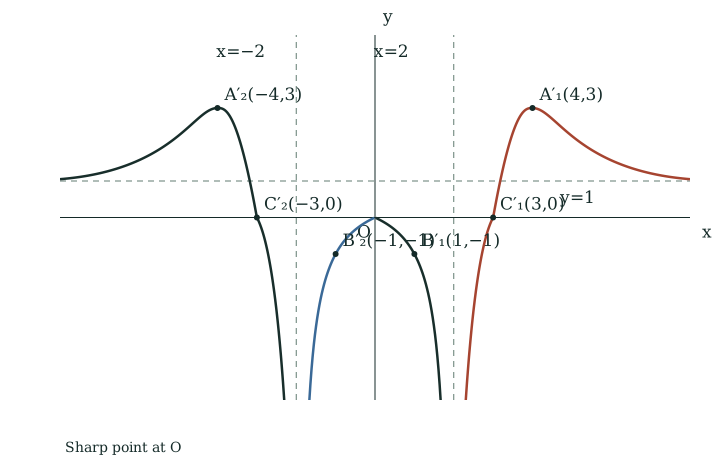
Answer · (ii)
; asymptotes .
Sharp point at the origin.
Keep the right-hand part
For , , so . This part of the graph is unchanged, including , , and the asymptote .
Replace the left-hand part by a reflection
The original left-hand part is discarded. The right-hand part is reflected in the -axis, giving , , and a second vertical asymptote .
Look at the -axis
The graph passes through the origin, since , and here the two halves meet at a sharp point. The horizontal asymptote appears on both sides.
Explore the idea
Combined transformations
Sketch the graph of , showing the coordinates of the points corresponding to , and and the equations of the asymptotes.
Hint
Rewrite as or find a chain of three simple steps: translate, scale, reflect.
For transformations of , the effect is the inverse of what the sign suggests. Work with a point to check.
Track , , and the vertical asymptote through each step.
moves the graph left by 1. Putting a plus sign inside the bracket does the opposite of what it looks like.
Order matters when the transformations do not all commute. Translate, then scale, then reflect gives the stated order; check the answer with a point.
The short answer key prints , but the worked graph and give .
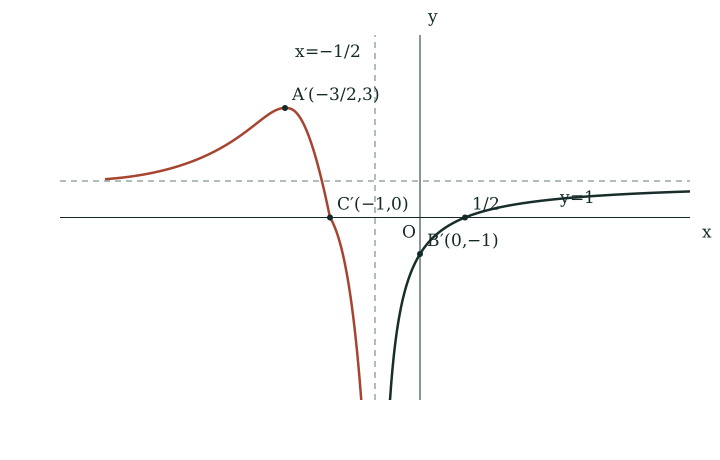
Answer · (iii)
; asymptotes .
The short-key positive B ordinate is a typo.
Translate:
This moves the graph 1 unit in the negative -direction: , , , asymptote .
Scale:
This halves every -coordinate (scale factor parallel to the -axis): , , , asymptote .
Reflect in the -axis:
Every -coordinate changes sign: , , , asymptote . The horizontal asymptote never moved.
Check with one point
For : we need , so . ✓. For : , so . ✓. For : , so . ✓
Explore the idea
The one-line check
For , a point on the original graph moves to . For : ✓. If your sketch disagrees with this formula, find the step where it went wrong.