Reconstruct signs from two absolute-value sketches
(a) Describe a sequence of exactly three transformations that will transform the curve with equation onto the curve with equation , where is a positive constant. marks
Given instead that , use a non-graphical method to determine the range of values of where the graph of is concave upwards. marks
(b) The diagrams below show the graphs of and , where the equations of the asymptotes and the coordinates of the turning points are given. The gradient of the graph with equation at the origin is .
On separate diagrams, sketch the graph of including the coordinates of the points where the graphs cross the - and -axes and the equations of the asymptotes, if any. marks
[2018/NJC/Prelim/I/8]
Solution
Describing transformations
Describe a sequence of exactly three transformations that will transform the curve onto the curve , where is a positive constant.
Hint
Write in the form by splitting the fraction.
Compare it with and name each operation: reflect, stretch, translate.
The transformations are hidden until you split the fraction. Always rewrite as (constant) + (a multiple of a simple reciprocal).
Stretching after translating would also stretch the . The stretch must come before the translation.
Answer · (a)i
Reflect in the x-axis, stretch vertically by , then translate down 2.
For this transformation question a>0.
Rewrite the target
, so .
Reflect in the -axis
The minus sign in front of the fraction.
Stretch parallel to the -axis by
Multiply every -coordinate by (a positive number, because ).
Translate 2 units down
The shifts the horizontal asymptote from to . The vertical asymptote never moves.
Explore the idea
Concavity by calculus
Given instead that , use a non-graphical method to determine the range of values of where the graph of is concave upwards.
Hint
Differentiate twice using .
Concave upwards means .
Use to decide the sign of .
With the answer would be . The condition flips it.
The curve is not defined at , and the strict inequality excludes it.
Answer · (a)ii
.
For the alternative assumption a<−6.
First derivative
Differentiate : .
Second derivative
Differentiate : .
Use the sign of
The numerator is now positive, so the sign of is the sign of .
Solve the inequality
A cube is positive exactly when its base is positive.
Reconstructing a graph
The diagrams show the graphs of and , with asymptotes and marked, and a touching point at . The gradient of at the origin is . Sketch the graph of , including the points where it crosses the axes and the equations of any asymptotes.
Hint
For , , so the right half of the first diagram is the right half of .
For , compare with . The gradient at the origin is negative, so just to the left is positive and .
Combine the two halves.
only differs from where . On the left , so the left half is unchanged.
Without the gradient you cannot tell whether is positive or negative just left of .
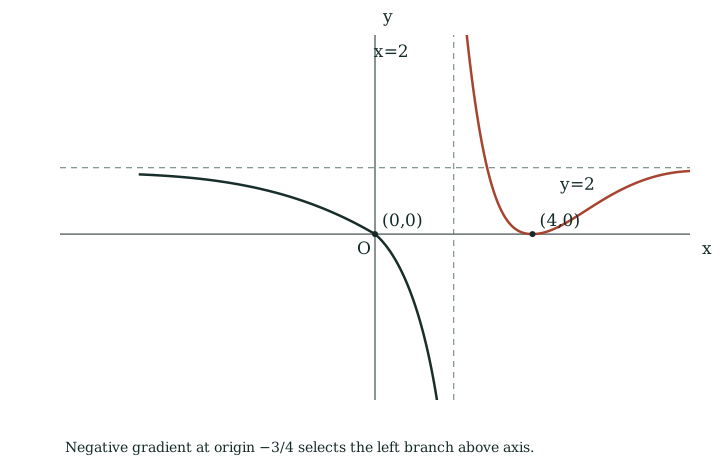
Answer · (b)
Intercept and touching point ; asymptotes .
Crosses O with slope −3/4; f<0 on (0,2), positive on both remaining source branches.
Right half from
For , . So the right-hand branches of the first diagram give for : through , going below the axis until the asymptote , and then the branch that touches the -axis at and approaches .
Left half from
For we use . Since the gradient at is , is positive just left of the origin, so there . The given left-hand branch has no further zero at which its sign could change, so this whole branch of is itself.
Check the signs
crosses the axis at with slope : positive for , negative on and positive again beyond the asymptote. It touches the axis at without crossing it.
Explore the idea