A squared inequality is a region between two branches
The curve has equation and the curve has equation , where is a positive constant. The horizontal asymptote of is a tangent to .
(i) Sketch , giving the equations of any asymptotes and the coordinates of any turning points. marks
(ii) Explain why . mark
(iii) On the same diagram as , sketch showing the coordinates of the points of intersection of . marks
(iv) It is given that if , then . Using this result and the graphs in part (iii), solve the inequality . marks
[2016/DHS/Promo/10]
Solution
Hyperbolas
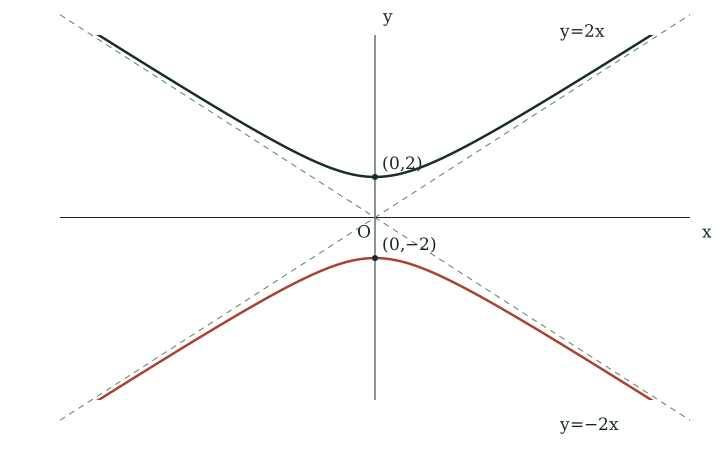
The curve has equation . Sketch , giving the equations of any asymptotes and the coordinates of any turning points.
Hint
Which variable has the plus sign? That tells you the branches open up and down.
Asymptotes: replace 1 by 0.
Vertices: put .
has positive, so it opens vertically, not horizontally.
Answer · (i)
Vertices ; asymptotes .
Asymptotes
For large the is negligible.
Vertices (turning points)
Each branch has one turning point.
Branches
Solving for gives an upper branch () and a lower branch ().
Explore the idea
Tangency
The curve has equation , where is a positive constant. The horizontal asymptote of is a tangent to . Explain why .
Hint
What is the horizontal asymptote of ?
Which horizontal lines are tangent to ?
is also tangent, but rules it out.
Answer · (ii)
.
Asymptote of
As , .
Horizontal tangents to
The only points of with a horizontal tangent are the vertices.
Choose by the sign of
is positive, so the tangent line is and .
Intersections
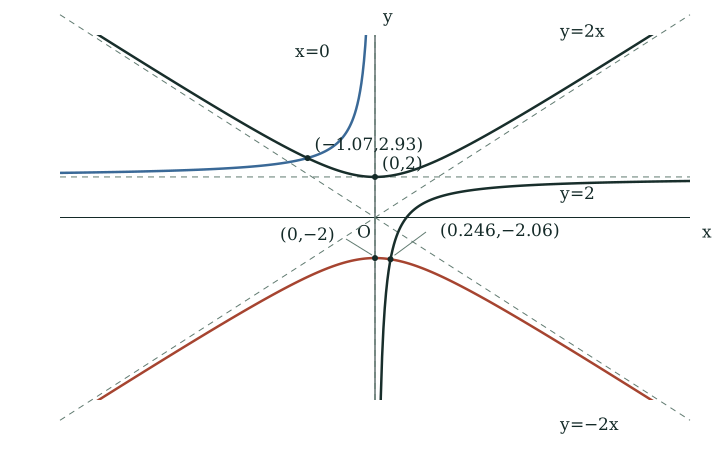
On the same diagram as , sketch , showing the coordinates of the points of intersection of and .
Hint
is : asymptotes and .
Find where it meets the hyperbola with a graphing calculator.
Left branch of ↔ upper hyperbola branch; right branch ↔ lower hyperbola branch.
Answer · (iii)
Intersections and .
Shape of
A reflected, shifted reciprocal. Both branches rise (since ). The left branch is above , the right branch below.
Intersections (GC)
The left branch meets the upper branch of ; the right branch meets the lower branch of .
Explore the idea
Inequalities from graphs
Given that if then , use this result and the graphs in part (iii) to solve the inequality .
Hint
Take and .
Then , which is the upper branch of .
Read the inequality as: lies between the two branches of .
is undefined at , and in any case lies in the excluded gap.
The inequality has both a lower bound and an upper bound, so both branches of matter.
Answer · (iv)
or , where , .
α,β are the real roots of 4x⁴+4x−1=0; x=0 is outside these intervals.
Apply the given result
so .
Recognise the branches
is the upper branch of and the lower. The inequality says the curve lies between them.
Read from the graph
To the left of the first intersection, and to the right of the second, is inside the two branches. Between them it is outside (for , where is undefined).
Explore the idea