Identify a parametric self-intersection
A curve has parametric equation , , where .
(i) Show that the curve cuts the -axis at the point and the -axis at and . marks
(ii) Sketch , giving the equation of the line of symmetry. marks
(iii) Find the exact coordinates of the point where crosses itself. marks
[2020/NYJC/Promo/10]
Solution
Parametric intercepts
A curve has parametric equations , , where . Show that cuts the -axis at and the -axis at and .
Hint
-axis: put and find .
-axis: put , so .
has two solutions, and , giving two points on the -axis.
Answer · (i)
Intersections .
-axis:
: ✓. Factorising, and the quadratic has no real root.
-axis:
Two parameter values give .
Find the heights
Substitute each value into .
Sketching parametric curves
Sketch , giving the equation of the line of symmetry.
Hint
Replace by : what happens to and to ?
A reflection that keeps and negates is a reflection in .
The curve is not symmetric about the -axis. It is that changes sign.
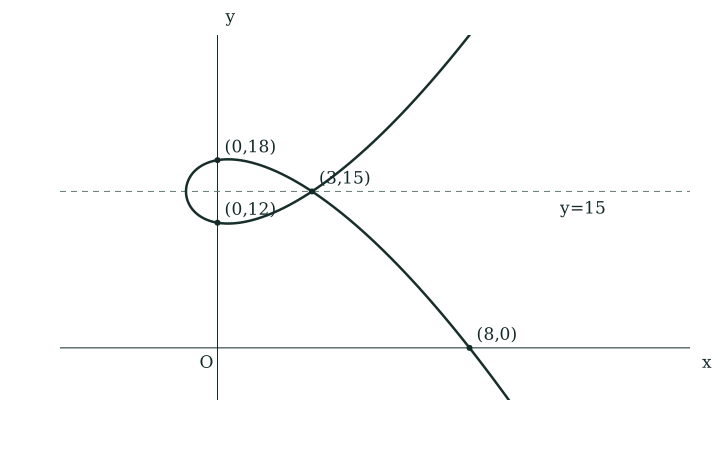
Answer · (ii)
Line of symmetry ; loop on .
Symmetry in
is even in , and is odd in .
Line of symmetry
Reflecting in the horizontal line swaps with and keeps , so the curve maps onto itself.
Shape
As goes from to the curve comes in from the top right, makes a loop with , and leaves to the bottom right (or the reverse). The loop closes at the self-intersection. On a graphing calculator, select parametric mode (the source uses radian mode), enter and , and include negative parameter values, for example . A useful window is , .
Explore the idea
Self-intersections
Find the exact coordinates of the point where crosses itself.
Hint
A self-intersection is a point reached by two different values of .
By symmetry it lies on . Solve for .
Reject the value that is not a crossing.
That point is visited only once (). A crossing needs two different parameter values.
Answer · (iii)
.
Use the symmetry
The crossing must lie on the line of symmetry, because the two parameter values are and .
Candidates
gives ; both give .
Choose the crossing
is a single parameter value, so is visited once (the leftmost point of the loop). and give the same point, which is therefore a crossing.