An exponential reflected at its zero
(i) Sketch , finding exact intercepts. marks
(ii) Without a calculator, solve with full working, giving the exact interval or intervals in their simplest form. marks
[2022/ACJC/Prelim/I/2]
Solution
Sketching a modulus curve
Sketch the graph of , finding the exact intercepts.
Hint
: an exponential decay.
Intercepts: for the -intercept; set the inside to 0 for the -intercept.
The inside tends to as , so the modulus gives the asymptote .
Without the modulus the graph would go negative; with it, the graph stays and has a corner at the -intercept.
, so the asymptote of the folded graph is .
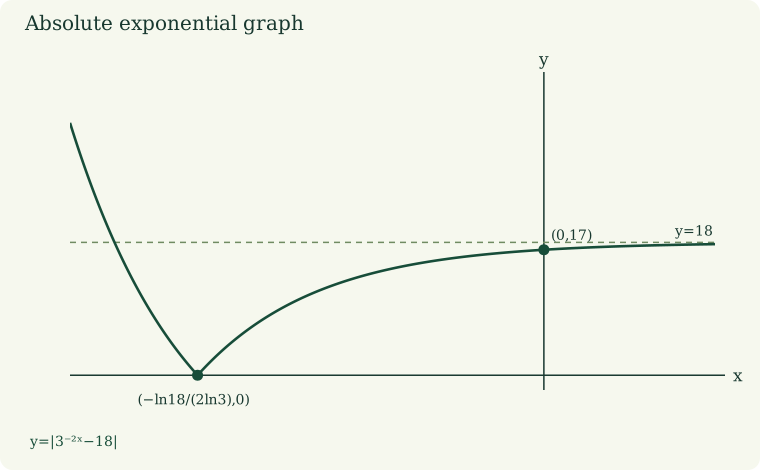
Answer · (i)
Intercepts and ; horizontal asymptote .
-intercept
.
-intercept
Take logs; the value is about .
Asymptote
The graph approaches 18 from below on the right.
Shape
For the inside is positive and the graph is the decaying exponential minus 18, falling to 0. At there is a sharp corner on the axis, and for the inside is negative so the folded graph rises towards 18.
Explore the idea
Absolute-value inequalities
Without a calculator, solve with full working, giving the exact interval or intervals in their simplest form.
Hint
means .
Add 18 to isolate .
Write the bounds as powers of 3 and compare exponents.
becomes , i.e. .
gives one chained inequality, not two alternatives.
Answer · (ii)
.
Remove the modulus
.
Isolate the exponential
Add 18 to every part. Graphically, the line meets the folded curve where or , giving and ; the curve is at or below the line between these points.
Write as powers of 3
and .
Compare exponents
is increasing, so the inequalities keep their direction. Dividing by reverses them and swaps the ends. Alternatively, base is decreasing: gives , with the same interval.
Explore the idea