All ellipse normals through a fixed point
MI Prelim 9758/2023/02/Q4. The curve has equation .
(i) Sketch curve , giving the exact coordinates of any points where the curve meets the axes. marks
(ii) Show that . mark
(iii) It is given that point is on . The normal to at passes through the point . Find the possible coordinates of . marks
[2023/MI/Prelim/II/4]
Solution
Sketching an ellipse
Sketch the curve : , giving the exact coordinates of any points where it meets the axes.
Hint
Divide by 20 to get the standard form.
Read off the intercepts.
The larger denominator (20) belongs to , so the ellipse is taller than it is wide.
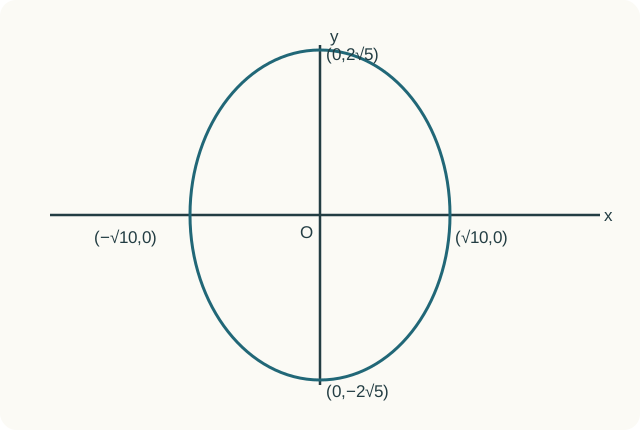
Answer · (i)
Ellipse: intercepts .
Standard form
Divide by 20. The semi-axes are (along ) and (along ).
Intercepts
.
Explore the idea
Implicit differentiation
Show that .
Hint
Differentiate each term with respect to .
At the tangent is vertical, and the formula does not apply.
Answer · (ii)
.
.
Differentiate
.
Solve
Rearrange (valid for ).
Normals through a point
is on and the normal at passes through . Find the possible coordinates of .
Hint
Normal gradient at is .
The normal passes through , so its gradient is also .
Solve the condition, **without dividing by **, and use the curve.
Cancelling loses the case and throws away two valid points. Factorise instead.
Answer · (iii)
or .
Retain both axis-point normals; dividing by b would lose them.
Gradient of the normal
For , the normal has slope , including slope zero when and the tangent is vertical. If , the normal is , which misses .
Normal through
For the displayed slope comparison, ; if , then , and the line joining to is vertical while the normal is not, so it gives no solution. Alternatively, substitute directly into to obtain without dividing by .
Case
On the -axis the normal is the horizontal line , which passes through .
Case
.
Explore the idea