Use the crossing before integrating an absolute value

(a) Use u=ex+2u=e^x+2 to find the exact value of ∫0ln⁡2e3xex+2dx\int_0^{\ln2}\frac{e^{3x}}{e^x+2}dx. marks

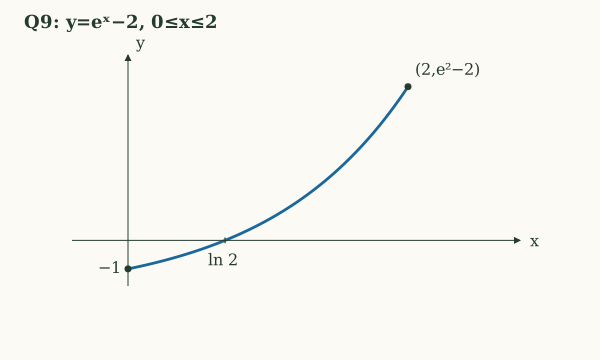
(b) Sketch y=ex−2y=e^x-2 for 0≤x≤20\le x\le2. State the exact xx where it crosses the xx-axis. marks

Hence find the exact value of ln⁡k\ln k such that

∫02∣ex−2∣dx=∫eek1xln⁡xdx.\int_0^2|e^x-2|dx=\int_e^{e^{\sqrt k}}\frac1{x\ln x}dx.
marks

[2011/TPJC/Prelim/I/9]

Total marks: 11

Solution

(a)

Integration by substitution

Use u=ex+2u=e^x+2 to find the exact value of ∫0ln⁡2e3xex+2 dx\int_0^{\ln2}\dfrac{e^{3x}}{e^x+2}\,dx.

Explore this idea

Hint

  1. Write e3x=e2x⋅exe^{3x}=e^{2x}\cdot e^x so that du=ex dxdu=e^x\,dx appears.

  2. Change the limits and divide.

Answer · (a)

4ln⁡(4/3)−1/24\ln(4/3)-1/2.

Explore the idea

The area from 0 to ln 2

Drag x. The shading shows the selected interval; the lower curves compare the numerical signed integral with the change in the antiderivative.

Upper limit xx = 0.69
Try an example

How the shaded areas add up

The limits run left to right. Area above the axis adds; area below the axis subtracts.

Above-axis contribution
0.651
Below-axis contribution
0
Signed integral
0.651

All three bars share one scale. Positive contributions extend right of zero; negative contributions extend left.

Signed integral from 0.00 to x
0.651
antiderivative − F(0)
0.651
agrees at displayed precision
Formula − integral
0
0.00% of the integral’s magnitude
Compare the running integral on a graph
  • Integrand
  • Numerical signed integral from the start to x
  • Part of the integrand above the axis
  • Part of the integrand below the axis
  • F(x) − F(start), from the antiderivative
Key idea

The area is 4ln⁡43−12≈0.6514\ln\frac43-\frac12\approx0.651.

Ideas to try
Drag xx to ln⁡2≈0.693\ln2\approx0.693 and read the area.
(b) sketch

Sketching an exponential

Sketch y=ex−2y=e^x-2 for 0≤x≤20\le x\le2 and state the exact xx where it crosses the xx-axis.

Explore this idea

Hint

  1. It is exe^x shifted down by 2.

  2. Find the intercepts and the end-points.

Exponential sketch
Exponential sketchScroll across to see the full diagram.

Answer · (b) sketch

Increasing convex curve; intercepts (0,−1),(ln⁡2,0)(0,-1),(\ln2,0), endpoint (2,e2−2)(2,e^2-2).

Explore the idea

e^x − 2 on [0, 2]

Switch on the end-points and the crossing.

Switch on a feature to add it to the sketch and see how it is found. A full-mark sketch shows all of them.

Ideas to try
Which part of the curve lies below the axis? How does that affect ∫02∣ex−2∣ dx\int_0^2|e^x-2|\,dx?
(b) constant

Absolute value integral

Hence find the exact value of ln⁡k\ln k such that ∫02∣ex−2∣ dx=∫eek1xln⁡x dx\int_0^2|e^x-2|\,dx=\int_e^{e^{\sqrt k}}\dfrac1{x\ln x}\,dx.

Explore this idea

Hint

  1. Split the left integral at x=ln⁡2x=\ln2.

  2. The right integral is ∫f′f\int\frac{f'}f with f=ln⁡xf=\ln x.

  3. Equate and solve for ln⁡k\ln k.

Answer · (b) constant

ln⁡k=2(e2+4ln⁡2−7)\ln k=2(e^2+4\ln2-7).

Explore the idea

The area splits at x = ln 2

Drag x. The shading shows the selected interval; the lower curves compare the numerical signed integral with the change in the antiderivative.

Upper limit xx = 2.00
Try an example

How the shaded areas add up

The limits run left to right. Area above the axis adds; area below the axis subtracts.

Above-axis contribution
3.162
Below-axis contribution
0
Signed integral
3.162

All three bars share one scale. Positive contributions extend right of zero; negative contributions extend left.

Signed integral from 0.00 to x
3.162
piecewise antiderivative
3.162
agrees at displayed precision
Formula − integral
0
0.00% of the integral’s magnitude
Compare the running integral on a graph
  • Integrand
  • Numerical signed integral from the start to x
  • Part of the integrand above the axis
  • Part of the integrand below the axis
  • F(x) − F(start), from the antiderivative
Key idea

Both halves of the area count as positive: 12ln⁡k=e2+4ln⁡2−7\frac12\ln k=e^2+4\ln2-7.

Ideas to try
  1. Drag xx to 2: the readout is e2+4ln⁡2−7≈3.16e^2+4\ln2-7\approx3.16.
  2. Where does the dashed curve change formula?