Cancel whole periods before you integrate
It is given that
and for all real , where is a positive real constant.
(a) Sketch for . marks
(b) Using the sketch, write down an equation relating and . mark
(c) Show , determining constants . marks
[2023/HCI/Prelim/I/7]
Solution
Sketching a periodic function
It is given that for and for , with for all real , where . Sketch for .
Hint
Sketch the tangent piece on . What are its end values?
Sketch the sine piece on . Does it join on continuously?
Repeat the pattern every to fill .
Here is only used on , so there are no asymptotes and the values stay between and .
The pieces are defined from to , not from to . Shift the pattern correctly.
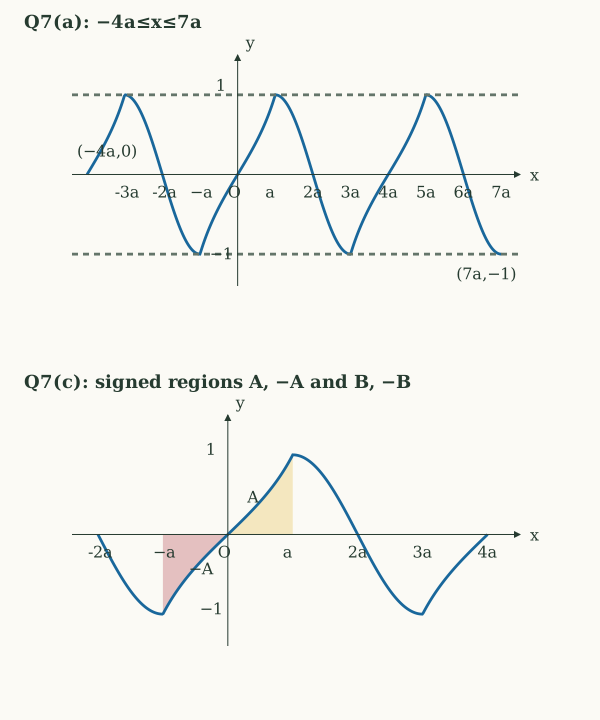
Answer · (a)
Period ; maxima at ; minima at ; zeros at .
; join the given tangent/sine pieces continuously.
The tangent piece
On the tangent piece rises smoothly through the origin towards its endpoint values. Its excluded left endpoint gets from the periodic sine piece, so the join is continuous.
The sine piece
From to it is half a sine wave: a maximum at , a zero at , a minimum at . Its value at is , matching the tangent piece, so the graph is continuous.
Repeat every
One period runs from to . The pattern repeats, with maxima at , minima at , and zeros at .
Explore the idea
Symmetry
Using your sketch, write down an equation relating and .
Hint
Look at the graph about the origin. Is it symmetric about the -axis, or does it rotate onto itself?
Even functions satisfy and are symmetric about the -axis. This graph is not.
Answer · (b)
.
Compare and
Rotating the graph through about the origin maps it onto itself. For example and . Functions with this property are called odd.
Integrating a periodic function
Show that , where and are constants to be determined.
Hint
Split at , , .
Which pieces cancel by oddness? Which are equal by periodicity?
Integrate the sine piece and the tangent piece that remain.
. A missing minus sign flips the answer's sign.
The antiderivative of carries , and for it carries .
The pieces over and contribute 0. They do not contribute their absolute areas, because the integral is signed.
Answer · (c)
; integral .
Signed integral, not total area.
Split the interval
Each sub-interval lies within one definition of , or is a shifted copy of one.
Cancel using oddness
The first is an odd function over a symmetric interval. For the second, the half-sine wave from to has equal positive area ( to ) and negative area ( to ).
Shift using periodicity
, so shifting an interval by does not change the integral. moves to , and moves back to .
Integrate the sine piece
and , so .
Integrate the tangent piece
and , so .
Add
So and . The integral is a signed value, and both remaining pieces lie below the -axis.
Look for cancellation first
Over a whole period, the integral of this function is 0. Over , which is one and a half periods, only half a period survives. Spotting that cuts the work to two short integrals.