A removable extension of the differential equation
(i) Find the general solution of the differential equation . marks
(ii) Sketch the particular solution of the differential equation in (i) for which and . marks
(iii) Describe the gradient of every solution curve as . mark
[2010/MI/Prelim/I/11(b) (modified)]
Solution
Direct integration
Find the general solution of .
Hint
Make the subject.
Integrate with respect to .
A general solution contains an arbitrary constant.
Answer · (i)
Original DE requires on each connected interval.
Rearrange
Multiply both sides by (for ).
Integrate
; so no modulus is needed.
Particular solution
Sketch the particular solution for which when .
Hint
Use the point to find .
Sketch .
The curve is symmetric about the -axis.
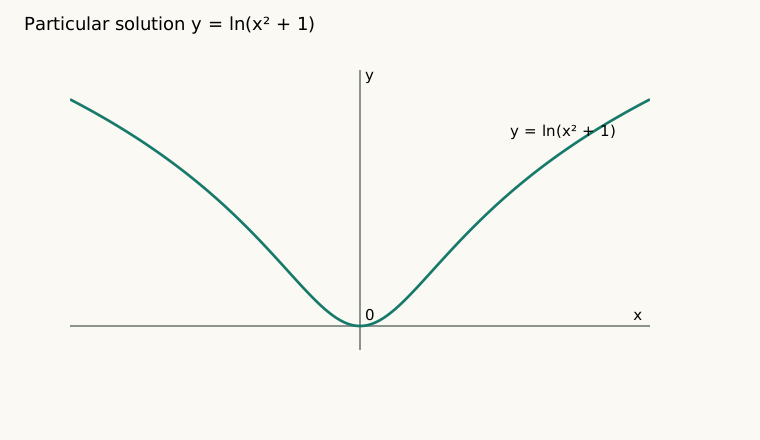
Answer · (ii)
: even, minimum (0,0), inflections at .
Uses the intended smooth extension through 0.
Find
The original equation excludes . The printed initial point uses its smooth extension , so , gives .
Shape
Even, minimum with a horizontal tangent since , increasing for ; inflection points at .
Explore the idea
Long-term gradient
Describe the gradient of every solution curve as .
Hint
Every solution has the same gradient function .
still grows without bound: only its gradient tends to 0.
Answer · (iii)
as .
Limit
Divide numerator and denominator by .