Separate the formal model from inconsistent pump directions
The cylindrical tank in a research laboratory has a cross-sectional area of 4 m². To cool the tank, water is pumped in and out of the tank simultaneously. The volume and height of the water in the tank at any time minutes is given by (m³) and (metres) respectively. Clean water is pumped into the tank at a rate that is proportional to and the water is pumped out from the tank at a rate that is proportional to .
(i) Assume that the water does not overflow and that there is no change to the height of the water when , show that where is a real constant. marks
The tank was initially filled with clean water to a height of 2 metres. When the height of the water is 5 metres, the volume of water is increasing at a rate of 5.5 m³ per minute.
(ii) Find the exact value of . Hence find in terms of . marks
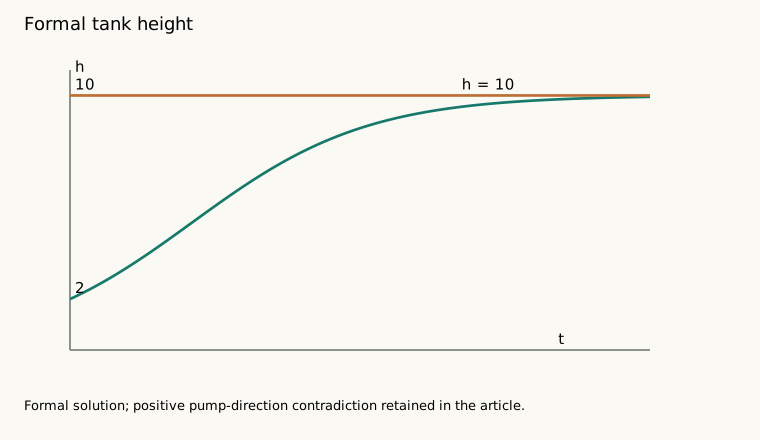
(iii) Sketch a graph of against . Hence write down the minimum height of the cylindrical tank that will not result in the overflow of the water. marks
[2022/ASRJC/Prelim/I/11]
Solution
Rate balance
Show that for a tank of cross-section 4 m², given inflow , outflow and no change at .
Hint
.
.
The inflow and outflow have different constants.
Answer · (i)
.
Rates
Net change is inflow minus outflow: neither rate alone is . Use independent constants before identifying the final constant . Positive physical pumping would require both constants to be positive.
Equilibrium
.
Height
Chain rule.
Rename
Solving
With initially and at , find and .
Hint
.
Separate with partial fractions.
The data force and : both would be negative pumped volumes. No positive physical pump constants satisfy all statements. Swapping the two proportional laws would repair the model, but would change the printed question.
Answer · (ii)
Formal answer: , .
Incompatible with positive printed inflow∝h² and outflow∝h; no positive physical constants satisfy all data.
Find
.
Separate
.
Partial fractions
.
Complete-square alternative
The difference-of-squares integral is . With the substitution , it gives exactly the same logarithm as partial fractions.
Solve
Exponentiate the logarithm with a sign absorbed into , then rearrange.
.
Explore the idea
Interpreting the graph
Sketch against and give the minimum tank height that avoids overflow.
Hint
As , .
The height only approaches 10; a tank of exactly 10 m just avoids overflow.
Answer · (iii)
Formal minimum tank height 10 m; height rises sigmoidally from 2 toward 10.
Conditional algebraic model, not a physically consistent solution of the printed pump description.
Limit
.
Sketch
The formal curve for rises from , passes its inflection at , and tends to the asymptote . This graph follows the algebraic model despite the printed pump-direction contradiction.