Logistic proportions and the first whole week
A flu virus is spreading in a community which has a fixed population of people. Scientists discover that at time weeks from the beginning, the rate of change of the number of people who are infected is proportional to the product of the number of people infected, , and the number of people who are not infected.
(i) Write down a differential equation relating . mark
It is noted that at the beginning, 1% of the people in the community is infected with the virus. 12 weeks later, the proportion of people infected in the community has risen to 25%.
(ii) By solving the differential equation obtained in part (i), show that . marks
(iii) Find the least number of weeks needed for the proportion of people infected to exceed 50%, giving your answer to the nearest integer. marks
(iv) Sketch the graph of against . Explain, with justification, what happens to the number of people infected if this situation continues indefinitely. marks
(v) State a possible limitation of the model in part (i). mark
[2021/HCI/Prelim/I/10]
Solution
Forming the equation
Write down a differential equation for the infected number in a population .
Hint
Rate proportional to .
The not-infected count is .
Answer · (i)
, .
Equation
Not infected .
Logistic solution
With 1% infected at the start and 25% after 12 weeks, show .
Hint
Partial fractions: .
The odds are and .
Answer · (ii)
.
Separate
Partial fractions: gives by setting . The initial trajectory has .
Complete-square alternative
Substitute in the difference-of-squares integral. It gives , the same result as partial fractions.
Integrate
Exponentiate.
,
Odds .
,
Odds .
Solve for
.
Explore the idea
First whole week
Find the least number of weeks for the proportion infected to exceed 50%.
Hint
.
At 15 weeks the proportion is still below 50%.
Answer · (iii)
weeks.
Inequality
.
Solve
Take logs.
Calculator intersection alternative
Plot and . On the source calculator use 2nd [calc] → 5:intersect; the crossing is .
Calculator zero alternative
Plot the shifted proportion and use 2nd [calc] → 2:zero. It gives the same crossing. The strict exceedance is after the exact crossing, not an exact threshold of 15.8.
Whole weeks
The first integer above 15.8.
Long-term behaviour
Sketch against and describe what happens if the situation continues indefinitely.
Hint
.
The curve approaches but never reaches it in finite time.
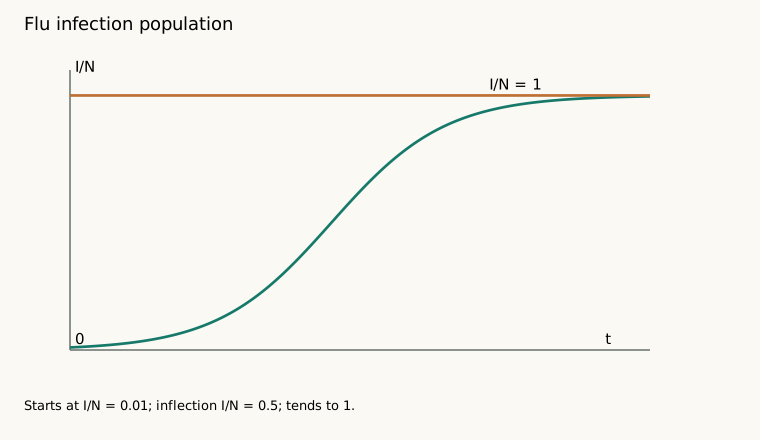
Answer · (iv)
Rises sigmoidally from toward , with inflection at .
Limit
Under the fixed-population, no-recovery assumptions, , so the modeled infected fraction approaches 1. It never equals 1 at finite time.
Shape
S-shaped, inflection at where the growth rate is largest.
Limitation
State a possible limitation of the model.
Hint
Think about the assumptions: fixed population, no recovery or immunity.
Name the specific assumption that fails.
Answer · (v)
Fixed population and no recovery/immunity limit the model.
A limitation
The model ignores recovery, immunity, vaccination and changes in the population.