What can go in, and what can come out?
Read domains and ranges as sets, including turning points and values that are only approached.
← Back to lesson · Complete chapter reading and print view · Open reference notes separately
By the end, you can
- Distinguish allowed inputs from reached outputs
- Find a range using endpoints and turning points
- Explain open and closed interval boundaries
about 20 minutes for the lesson · practise at your own pace.
The central idea
The domain tells us which inputs are allowed. The range contains exactly the outputs reached from those inputs. For with , the domain is and the range is . Squaring never gives a negative value, and reaches the lower boundary.
Four representations of a relation
Expand diagramFit diagram to page
Use the scrollbars or arrow keys to inspect details.
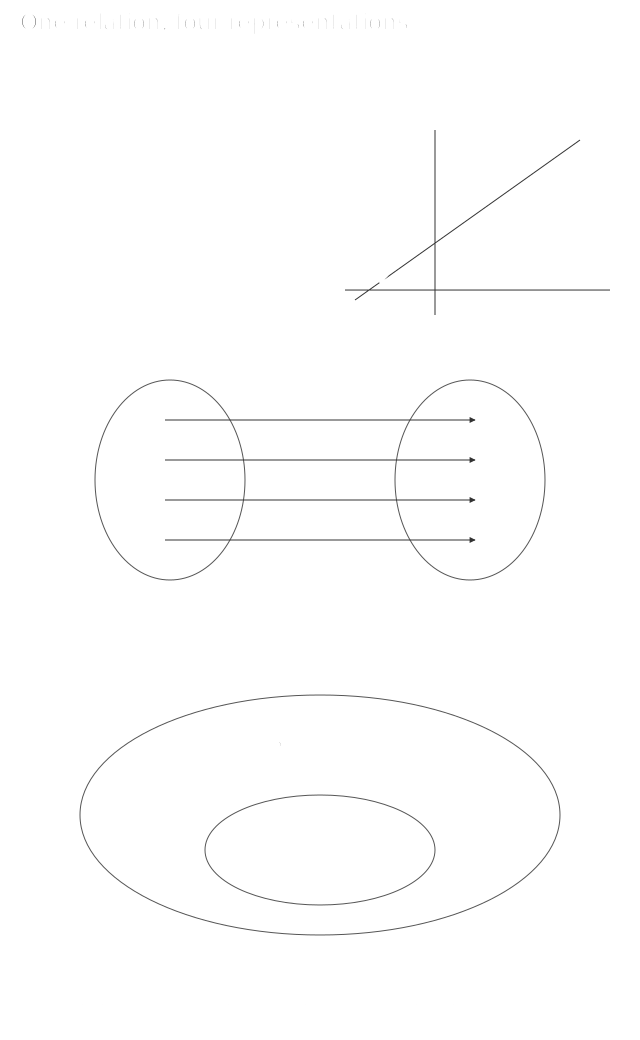
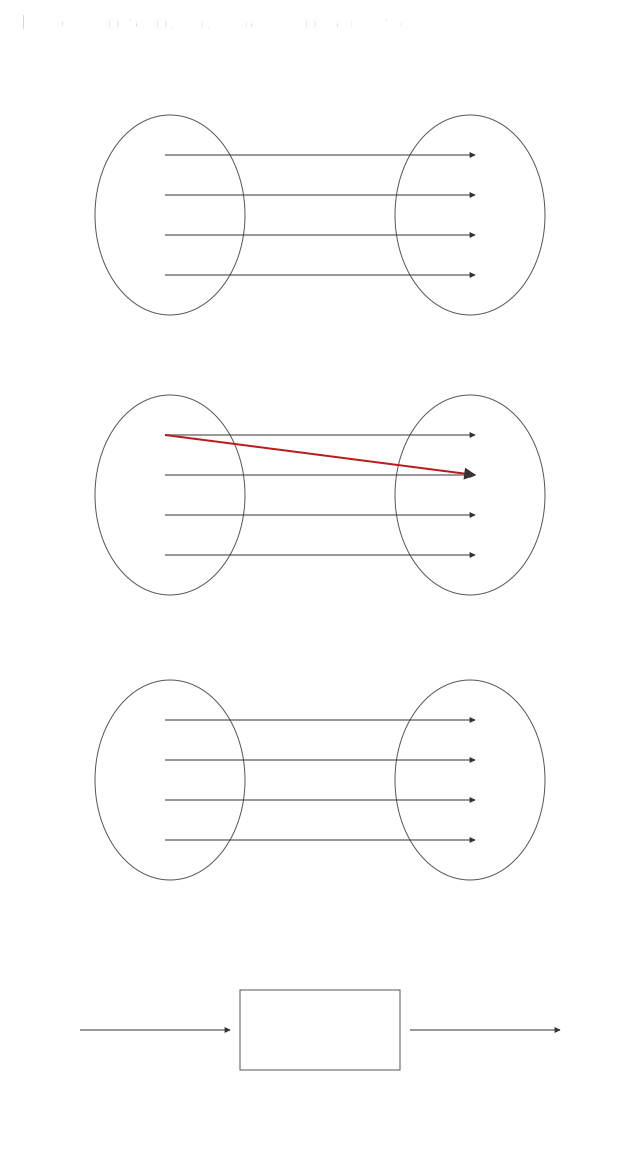
One output per input, and the square mapping
Expand diagramFit diagram to page
Use the scrollbars or arrow keys to inspect details.
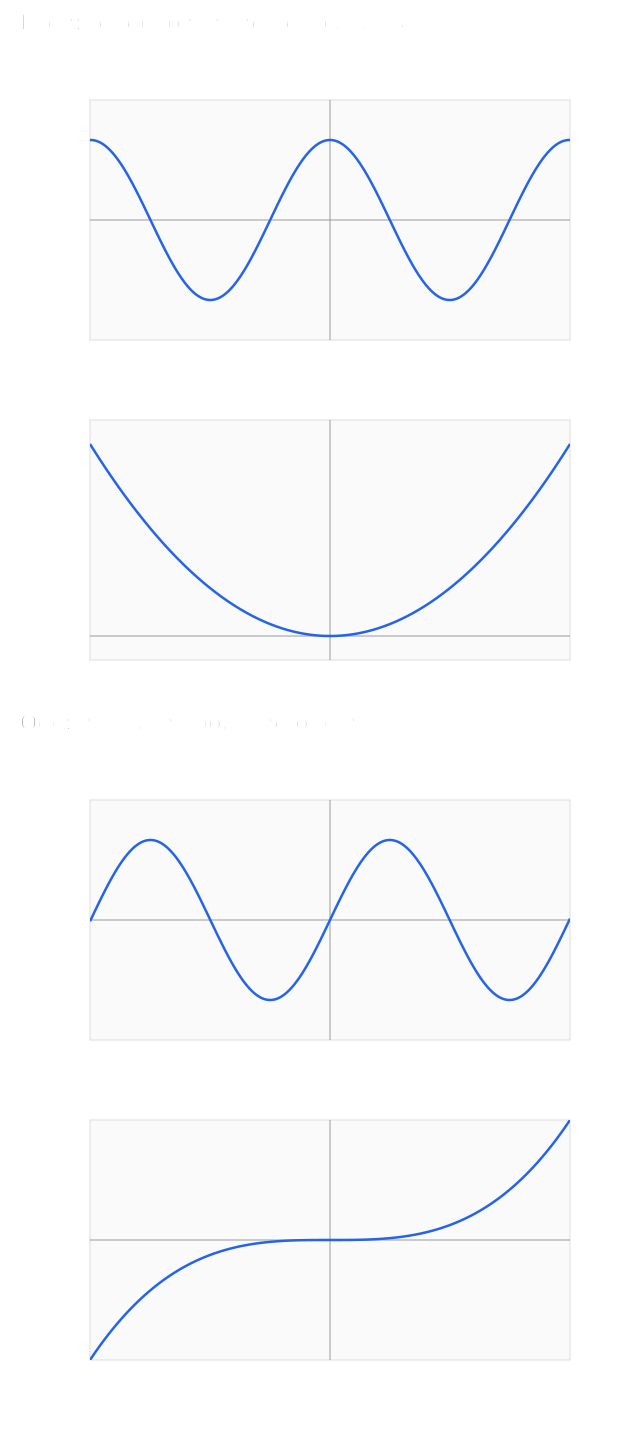
Even and odd source curves
Expand diagramFit diagram to page
Use the scrollbars or arrow keys to inspect details.
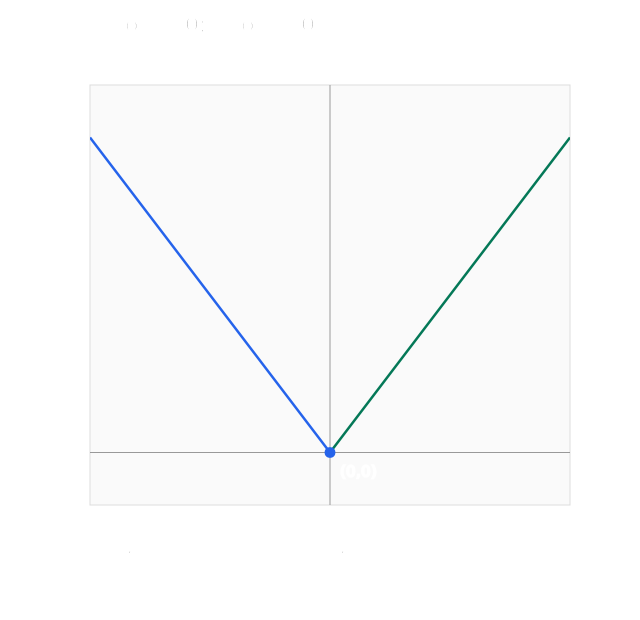
Modulus selects one of two rules
Expand diagramFit diagram to page
Use the scrollbars or arrow keys to inspect details.
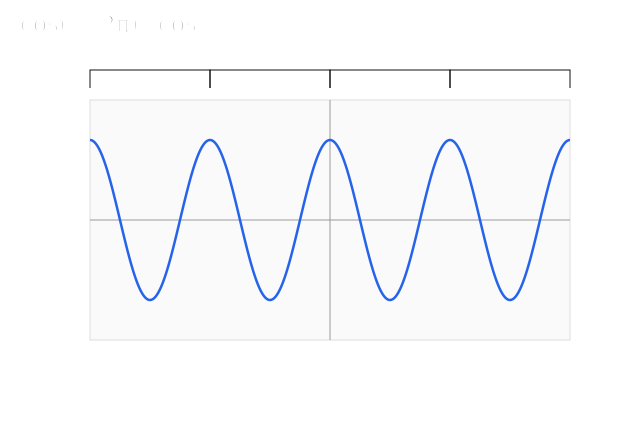
Cosine repeats after two pi
Expand diagramFit diagram to page
Use the scrollbars or arrow keys to inspect details.
Explore
Move the left boundary. Opening it excludes that endpoint. When the boundary passes the turning point, the minimum changes.
Worked example
For on , the input boundary is excluded, but is still allowed and reaches . The range is therefore . For , the graph is increasing throughout the allowed domain and its lower output limit is 0, never reached. Now the range is .
A bracket in the domain does not transfer directly into a bracket in the range. Ask whether the output is reached anywhere in the allowed domain.
Check your understanding
Find the range of on . Does excluding the input 1 exclude the minimum output?
The range is . The vertex input is allowed and reaches 2. Excluding the left boundary 1 does not remove the minimum.
Practice questions
Practice section 1 · Questions 1–6
Translate all seven interval rows · Substitute a complete input expression · +4 more
Practice section 2 · Questions 7–11
Repeat the defining interval without losing endpoints · Three ranges, three endpoint decisions · +3 more
More practice
Practise reading ranges before using them to decide whether an inverse or a composite exists.
- When can two functions compose?State the range of the square root, then the range of the composite.Open question and interactive solution →
- Restrict the domain to choose an inversePart (i): the maximum 2 is reached and 0 is not.Open question and interactive solution →
- Map the whole interval, not only its endpointsFind a composite range with an interior minimum.Open question and interactive solution →
Ready to try this on your own?
For “What can go in, and what can come out?”, try a question without the working and explain your method. This records your confidence, saved in this browser only.