Reflect then reciprocate; translate then fold
The diagram below shows the graph of . The curve cuts the axes at and . It has a maximum point at , and asymptotes and .
Sketch on separate diagrams, the graphs of
(i) ; marks
(ii) . marks
showing clearly asymptotes, intercepts and coordinates of turning points, where available.
[modified 2010/ACJC/Prelim/I/3]
Solution
Reciprocal and reflection
Sketch the graph of , showing clearly asymptotes, intercepts and coordinates of turning points, where available.
Hint
Find first: zeros become asymptotes, the maximum becomes a minimum.
Then replace by : reflect in the -axis.
Check the point where was undefined: what happens to there?
The old vertical asymptote at became an open point at after the reflection. The graph approaches but never touches it.
The asymptote of becomes after the reflection.
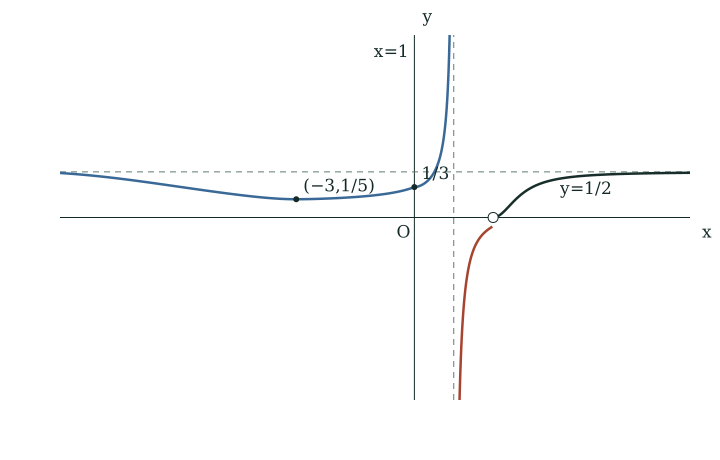
Answer · (i)
Minimum ; intercept ; asymptotes ; hole .
No x-intercepts.
Reciprocal:
Reflection in the -axis and taking reciprocals can be done in either order: both give . The old zero becomes a vertical asymptote. The maximum becomes the minimum . The old vertical asymptote becomes an open point because is undefined there.
Reflect in the -axis:
Every -coordinate changes sign: minimum , -intercept unchanged, vertical asymptote , open point . The horizontal asymptote is unchanged.
Explore the idea
Translation and modulus
Sketch the graph of , showing clearly asymptotes, intercepts and coordinates of turning points, where available.
Hint
First draw . Which direction, and what happens to the asymptote?
Then apply the modulus: reflect any part below the -axis upward.
Where the graph meets the -axis at a sharp point.
translates the graph down by 4. The -intercept becomes .
The asymptote after translating is . The modulus makes it , and the printed answer's label must read .
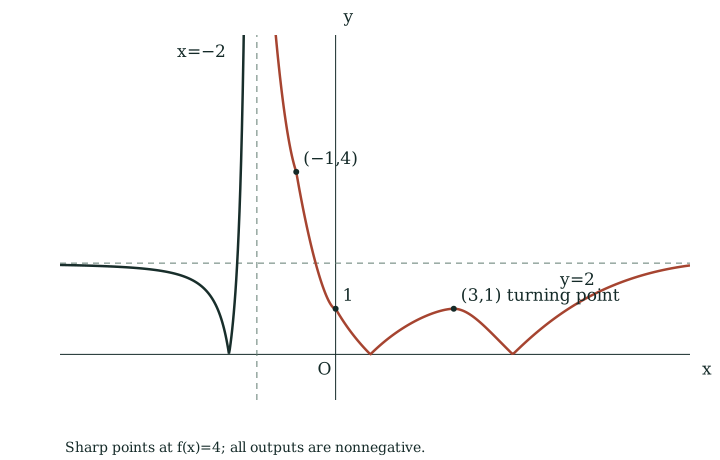
Answer · (ii)
Local maximum ; points ; asymptotes .
Three sharp minima occur where f(x)=4; exact abscissae are unspecified.
Translate 4 units down
, , maximum . The asymptote moves to .
Fold with the modulus
Parts below the -axis reflect upwards: and . The maximum lies above the axis, so it stays. The asymptote becomes .
Sharp points
Where the translated graph crosses the -axis, and the modulus turns each crossing into a sharp minimum on the -axis. Their exact positions are not required.
Explore the idea