A family of lines can miss a rational curve
The curve has equation , where .
(i) State the coordinates of the intersection(s) of the curve with the axes in terms of . mark
(ii) Find the equation(s) of the asymptote(s). marks
(iii) Draw a sketch of the curve , labelling the equation(s) of its asymptote(s) and coordinates of any intersection with the axes. marks
(iv) Hence find the range of values of , where is a positive constant, for which the equation has no real root. marks
[2009/SRJC/Prelim/I/7]
Solution
Intercepts
The curve has equation , where and . State the coordinates of the intersection(s) of with the axes in terms of and .
Hint
-intercept: . -intercept: .
, so and there are no real roots.
Answer · (i)
Only ; no x-intercept.
-intercepts
Since this has no real solution, so there is no -intercept.
-intercept
Substitute .
Asymptotes
Find the equation(s) of the asymptote(s) of .
Hint
Vertical: zero of the denominator.
Oblique: divide the numerator by the denominator and read the quotient.
The numerator has higher degree than the denominator, so . The long-run behaviour is a slanted line.
Answer · (ii)
.
Polynomial division
, so .
Read off
The remainder fraction for large , so .
Curve sketching
Draw a sketch of , labelling the equation(s) of its asymptote(s) and the coordinates of any intersection with the axes.
Hint
Draw the two asymptotes first.
Which side of each does the curve lie? Look at the sign of .
Place the intercept .
There is no -intercept and .
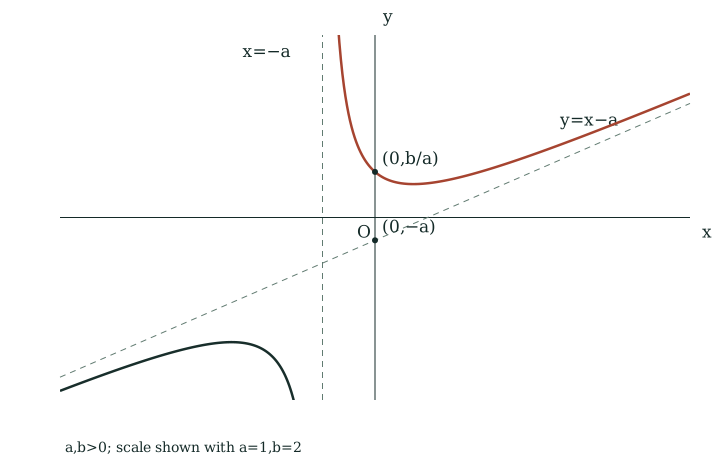
Answer · (iii)
Negative branch for , positive branch for , with the stated intercept/asymptotes.
; representative parameter sketch.
Position relative to the oblique asymptote
This is positive for and negative for , so the right branch lies above the asymptote and the left branch below it.
Branches
Right of : the curve comes down from , passes through , reaches a minimum, and climbs along the line. Left of : it comes from along the line, reaches a maximum, and drops to at the asymptote.
Explore the idea
Roots from a graph
Hence find the range of values of , where is a positive constant, for which the equation has no real root.
Hint
Divide by to compare the curve with the line .
The line passes through and has gradient .
Which gradients give a line that never meets the curve?
Multiplying out gives a quadratic whose leading coefficient vanishes at . The graph handles this degenerate case cleanly.
The line is the asymptote itself; it approaches the curve without meeting it, so is included.
Answer · (iv)
.
Rearrange
Valid for . At , the original equation would require , impossible since , so no root is lost. Now each side is something we can graph.
Interpret the line
has gradient and passes through , a point below the -intercept of . Real roots are the intersections of the line with .
Compare with the asymptote
The asymptote also passes through . For the line is below the asymptote when , hence below the right branch, and above the asymptote when , hence above the left branch. On the remaining interval , the curve is positive because and , while the line is negative. So it never meets . At the line is the asymptote itself and never meets either.
Explore the idea