Use a circle to test negative roots
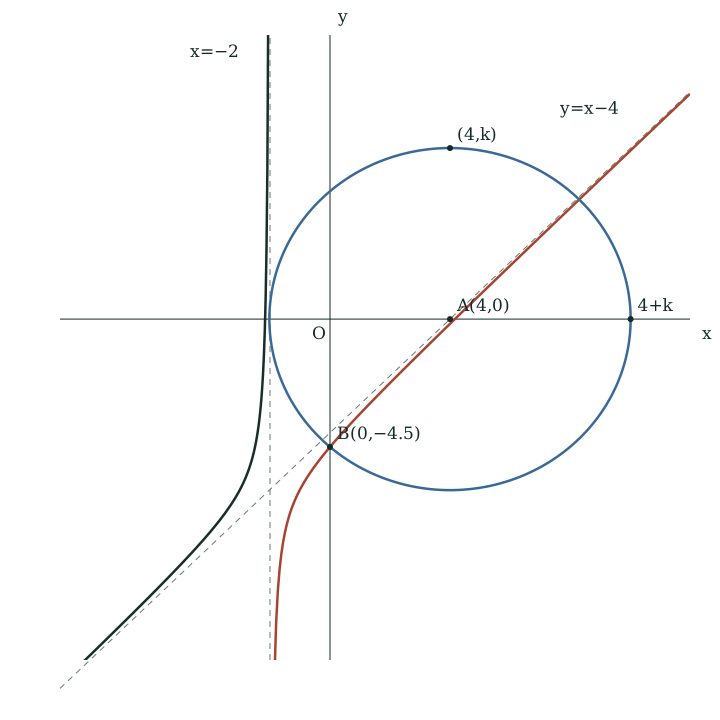
The diagram below shows a sketch of the graph of where are constants. The asymptotes, also shown in the diagram, are and .
(i) Write down the value of and find the values of . marks
(ii) Given that the curve passes through the point , find the value of . mark
(iii) By drawing a suitable curve on the same diagram shown above, determine the range of values of such that the equation , where are the values found above, has at least one negative root. marks
[modified 2010/RVHS/Prelim/I/7]
Solution
Asymptotes and coefficients
The graph of , where are constants, has asymptotes and . Write down the value of and find the values of and .
Hint
The vertical asymptote is where the denominator vanishes.
The oblique asymptote is the quotient of the division. Write and combine over .
Compare coefficients.
The asymptote only fixes the quotient. The constant term stays unknown until part (ii).
Answer · (i)
.
Vertical asymptote
The denominator is .
Rewrite using the oblique asymptote
The oblique asymptote means the quotient is and the remainder is a constant.
Compare coefficients
Match with .
Substitution
Given that the curve passes through the point , find the value of .
Hint
Substitute into .
The point is : and .
Answer · (ii)
.
Substitute
At the numerator is and the denominator is .
Circles and loci
By drawing a suitable curve on the same diagram, determine the range of values of such that the equation , with the values found above, has at least one negative root.
Hint
Let . Then the equation says : the point is at distance from .
So the curve and the circle of centre , radius must meet at a point with .
How small can that radius be? The nearest approach to for .
appears in the equation, so and give the same circle. Both signs are included.
At the root is exactly , which is not negative.
Answer · (iii)
.
Equality reaches x=0, not a negative root.
Interpret geometrically
Roots of the equation are the -coordinates of the points where this circle meets the curve .
Which part of the curve?
A negative root means an intersection at . The sketch shows the boundary distance is approached as the right-hand branch tends to the -intercept from . The point itself has and is excluded from the negative-root requirement.
Distance to the nearest point
and . A circle only reaches the part of the curve once its radius exceeds .
State the range
At the circle just reaches at , which is not a negative root, so the inequality is strict.
Explore the idea