Matching rules are not equal without matching domains
The function is defined by , , , where is a constant. It is given that is the least possible value such that exists.
(i) State the value of . mark
(ii) Hence find and state the domain of . marks
(iii) Sketch on the same diagram the graphs of , and , giving the coordinates of all end points. marks
It is now given that is replaced by a constant such that the functions and are equal.
(iv) Explain why the new value of satisfies the equation , and find . marks
(v) The function is defined by , . Explain why composite does not exist. mark
[2021/EJC/Promo/8]
Solution
One-one restrictions
for real . Given that is the least value such that exists, state .
Hint
The graph of is V-shaped: falling to a minimum at , then rising.
A one-one piece must stay on one side of the minimum.
On the graph falls then rises, so it is not one-one.
Answer · (i)
.
Turning point
The unrestricted formula has its minimum at . Restrict to to keep an increasing branch; the endpoint itself is excluded.
Explore the idea
Inverse functions
Find and state its domain.
Hint
For , .
Solve for .
.
Without the sign argument, has two branches. The domain picks the plus sign.
Answer · (ii)
, .
Remove the modulus
On this domain .
Make the subject
Take natural logs.
Domain
As , (open). As , .
Graphs of inverses and composites
Sketch , and on the same diagram, giving the coordinates of all end-points.
Hint
: starts just right of and rises. : reflection, starting just above .
with domain .
The three graphs meet where would be, but here at no common point.
All three domains are open at their left end.
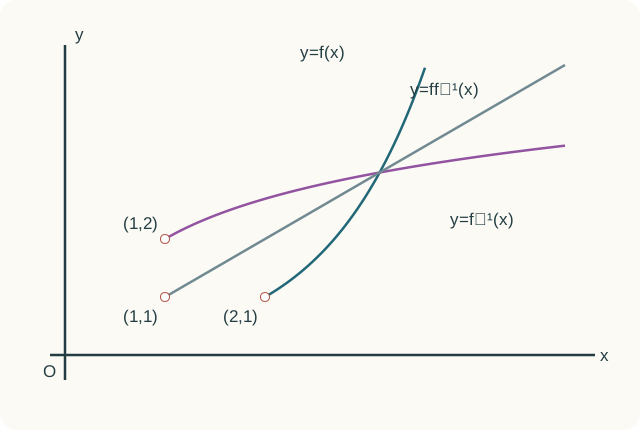
Answer · (iii)
Open endpoints for f, for inverse, for .
End-points
Every domain is open at its start.
The composite
For , , so .
Explore the idea
Equality of composite functions
is now replaced by a constant for which and are equal functions. Explain why , and find .
Hint
Both composites equal , so their domains must match.
and .
So .
Two functions are equal only when their rules and their domains match.
Answer · (iv)
; admissible root (3 s.f.).
; more precisely 3.14619….
Domains must match
The domain of a composite is the domain of its inner function. starts at because is increasing.
Equate the starting points
forces the left ends to agree. Here means the limiting endpoint value of the formula: is excluded from the function domain. Inverse existence permits , but does not satisfy the equal-domain condition.
Solve
here so . This is a transcendental equation: solve it on a calculator.
Numerical root
, so (the other root of is below 2, which is not allowed).
Explore the idea
Existence of composites
for . Explain why does not exist.
Hint
exists if .
Find one output that is not in the domain.
The rule is fine for any real number. It is the domain that causes the problem.
Answer · (v)
does not exist: .
A counterexample
is not an integer, so it cannot be fed back into .