A quarter ellipse becomes a self-inverse circle
Sketch the curve for , , where is positive. mark
, , ; , , .
Show that exists and define in a similar form. marks
Given for all , ,
(i) show without evaluating , marks
(ii) using (i), show exists and find its corresponding range. marks
[2011/ACJC/Prelim/I/9]
Solution
Sketching conics
Sketch for , , where .
Hint
Divide by 5: is an ellipse.
Find the intercepts and keep the first quadrant.
The question restricts to .
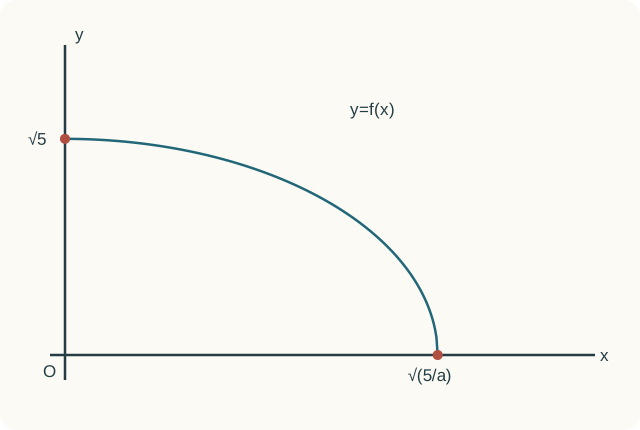
Answer · Sketch
Quarter-ellipse endpoints .
, x,y≥0.
Intercepts
Substitute into the equation.
Shape
A quarter of an ellipse from down to , decreasing and concave.
Explore the idea
Inverse functions
for . Show that exists and define it in a similar form.
Hint
Show is one-one: any horizontal line meets the graph at most once.
Rearrange for .
.
in the domain of , so only the positive square root is taken.
Answer · Inverse
, .
Strictly decreasing original f is one-one.
One-one
The graph falls steadily from to . Every horizontal line cuts it at most once, so is one-one and exists.
Make the subject
, so take the positive root.
State it
.
Self-inverse by symmetry
Given for all in the domain, show that without evaluating .
Hint
means .
A function equal to its inverse has equal domain and range, .
The question says not to evaluate . Use and compare domains.
Answer · (i)
.
Identity on the entire domain forces Df=Rf.
Self-inverse
Apply to both sides, using .
Equal domains
Two equal functions have the same domain.
Compare end-points
Square both sides. Alternatively, equate the inverse rules at input 0: gives . Geometrically, a self-inverse ellipse arc is symmetric about , so its two intercepts agree and it is a quarter-circle.
Explore the idea
Range of a composite
for . Show that exists and find its range.
Hint
With , .
Find and compare.
Feed through .
is decreasing: the open end swaps to the top and the closed end to the bottom.
Answer · (ii)
exists and .
Range of
is decreasing, with horizontal asymptote .
Compare
.
Range of
is decreasing, so the open end at input 1 gives the open end at output 2.
Explore the idea