Composition conditions and a hidden constant case
Functions , , ; , , , where are constants.
(i) Sketch , giving coordinates of turning points and equations of asymptotes. Write down the range of . marks
(ii) Find the value of and range of such that both and exist. marks
(iii) Find . Given for all real , , find in terms of . marks
[2019/TJC/Promo/9]
Solution
Sketching rational functions
for . Sketch giving the coordinates of the turning points and the equations of asymptotes. Write down the range of .
Hint
Divide to get .
Read off the asymptotes.
Differentiate for the turning points.
The two turning points leave a gap between and .
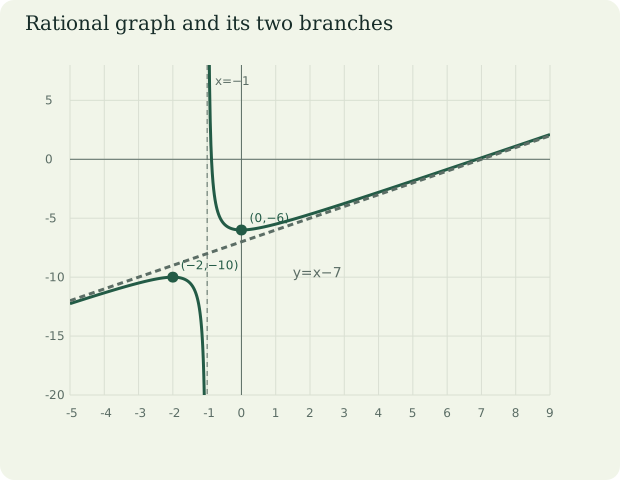
Answer · (i)
Asymptotes ; maximum , minimum ; range .
Divide
: .
Asymptotes
The term is unbounded near and tends to zero as grows. The short key labels the oblique line in error; division shows it is .
Turning points
.
Their coordinates
The left branch has a maximum, the right branch a minimum.
Range
The values are never reached: this is the gap.
Explore the idea