A particle switches from a curve to its normal
A particle is moving along a curve, , such that its position at time seconds after it is set into motion is given by the parametric equations , .
(i) State the coordinates of the initial position of the article. mark
(ii) Explain what would happen to the path of the particle after a long time. mark
At the time of 2 seconds after the particle was set into motion, an external force struck the particle resulting in the particle moving in a straight line along the normal to the path at the point of collision.
(iii) Find an equation for the normal to the curve at the point , leaving your answer correct to 3 decimal places. marks
After seconds, where , the particle reaches point , which lies on the -axis, and stops moving.
(iv) Find the coordinates of the point . Hence, give a sketch of the path traced by the particle, indicating the coordinates of any axial intercepts. marks
(v) Find the total area bounded by the path of the particle in the first seconds and the positive -axis. marks
[2017/SRJC/Prelim/I/10]
Solution
Parametric curves
and . State the initial position of the particle.
Hint
The motion starts at .
'Initial' means .
Answer · (i)
.
Substitute
.
Long-term behaviour
Explain what would happen to the path of the particle after a long time (with no impact).
Hint
Let and see which terms survive.
The coordinates themselves grow: only the gap to shrinks.
Answer · (ii)
Original parametric path approaches as .
The exponential vanishes
decays to 0.
The line
The gap between the curve and the line vanishes.
Explore the idea
Normals to parametric curves
At the particle is struck and moves along the normal. Find an equation for the normal to at , correct to 3 decimal places.
Hint
.
Normal gradient .
Use the point .
Keep unrounded values (like ) until the last line; rounding the gradient first changes the intercept.
Answer · (iii)
(3 d.p.).
Derivatives
Differentiate each coordinate.
At
.
Normal gradient
Negative reciprocal.
Equation
Expand and round to 3 d.p.
Axial intercepts of a composite path
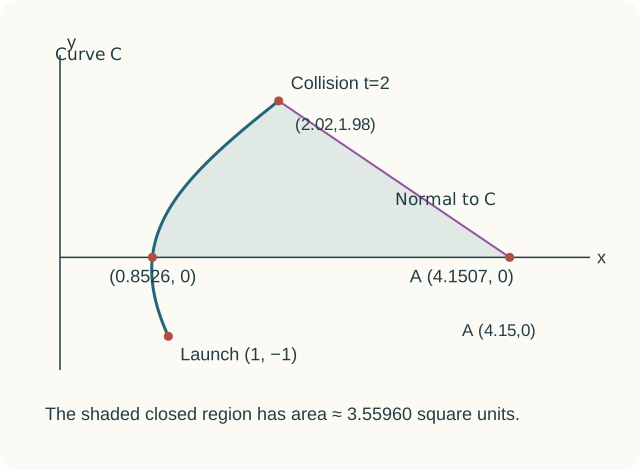
After seconds () the particle reaches the point on the -axis. Find , and sketch the path, indicating the coordinates of any axial intercepts.
Hint
is where the normal meets .
The curve itself crosses the -axis where .
Sketch the curve for followed by the straight segment.
The curved part crosses the -axis too, at .
Answer · (iv)
; initial point and curve x-intercept .
No y-axis intersection; follows curve until t=2, then its normal to A.
Normal meets the axis
Use the unrounded collision and normal values internally: . Round only the final coordinate.
Curve meets the axis
Solve numerically. At that moment .
Path
Start , rise through , continue to the collision point , then run straight down along the normal to .
Explore the idea
Area under a parametric path
Find the total area bounded by the path of the particle in the first seconds and the positive -axis.
Hint
The enclosed region begins where the curve crosses the -axis and ends at .
Curved part: from to .
Straight part: from to .
The initial arc below the axis does not, by itself, close a region with that axis. The bounded region starts at the curved path's positive-axis crossing, continues to the collision, and closes along the normal and the axis.
Answer · (v)
square units (3 s.f.).
The enclosed region begins at the curve’s x-axis crossing, not the free launch endpoint.
Curved part
Use and change the limits to the parameter values: the positive-axis crossing and the collision . Keep unrounded limits during evaluation.
Straight part
The region under the normal segment is a triangle with base and height . Use the unrounded line and endpoint values; the displayed decimals only summarize the calculation.
Total
Add the two areas.
Explore the idea