Find the region before you choose the radii
Curve C: .
(i) Without a calculator, determine its exact stationary point. marks
(ii) Sketch C, stating clearly any asymptotes. marks
R is bounded by C, and the -axis.
(iii) Find its exact area. marks
(iv) Find the volume when R is rotated radians about the -axis. marks
[2021/EJC/Prelim/II/4]
Solution
Stationary points
The curve has equation . Without a calculator, determine the exact coordinates of its stationary point.
Hint
Differentiate. The denominator is a quadratic, so use the chain rule on .
Set and solve.
Or complete the square first: the denominator is .
Writing the derivative as gives the opposite sign for the gradient and would turn the minimum into a maximum.
The question says exact, so write , not .
Answer · (i)
Minimum .
Differentiate
, so . The minus signs cancel.
Solve
The denominator is never zero, so only the numerator can vanish.
Check it is a minimum
The fraction is largest when , so is smallest at . The graph is symmetric about , and this is its lowest point.
Curve sketching
Sketch , stating clearly any asymptotes.
Hint
What happens to the fraction as ?
Find the -intercept () and the -intercepts ().
Plot the minimum from (i) and use the symmetry about .
“Stating clearly any asymptotes” earns a mark. Draw it dashed and write beside it.
for every , so the curve never touches .
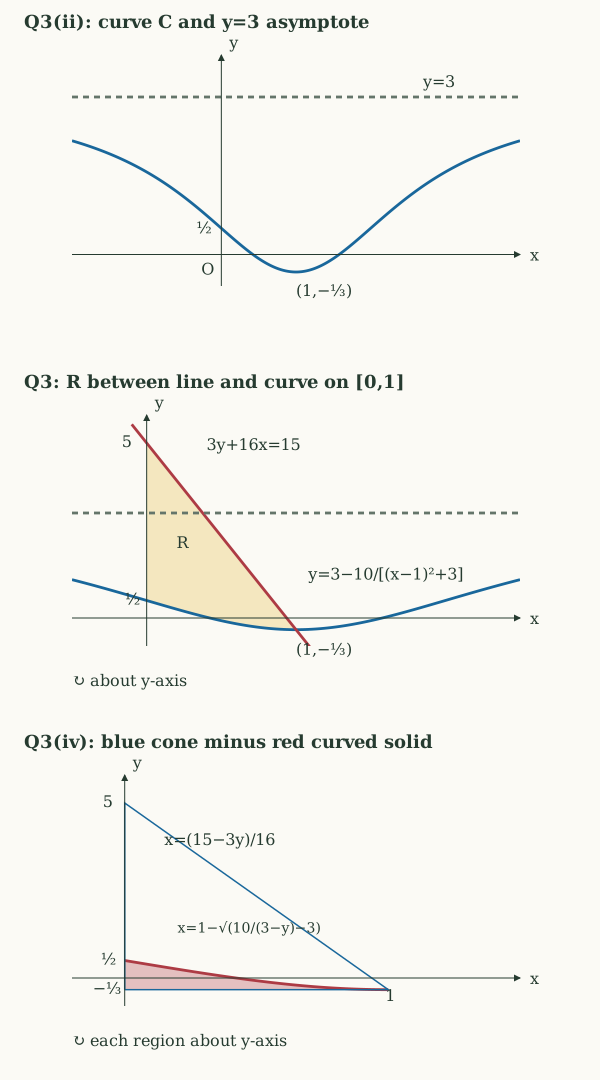
Answer · (ii)
Asymptote ; intercepts .
Asymptote
The curve approaches the horizontal asymptote from below, because the subtracted fraction is always positive.
Intercepts
Setting gives , so and .
Draw it
Draw a shallow bowl with its lowest point at , rising symmetrically towards the dashed line . Label the asymptote, the minimum and the three intercepts.
Explore the idea
Area between curves
is the region bounded by , the line and the -axis. Find its exact area.
Hint
Write the line as . It meets where? Try the minimum point.
Which is on top between and that point?
Integrate (line − curve). Expect an arctangent.
measures the area down to the -axis, and part of lies below it.
The antiderivative of carries , and it multiplies the 10.
Answer · (iii)
Area .
Find the limits
At the line passes through the minimum point of , so the line meets there. runs from to .
Set up
At the line is at and the curve at , so the line is on top.
Integrate
Use .
Substitute
At , . The area is about .
Explore the idea
Volume of revolution
Find the volume generated when is rotated through radians about the -axis.
Hint
Rotating about the -axis, slice horizontally, so everything must be a function of .
The outer boundary is the line. For low the inner boundary is the curve; for high it is the -axis itself.
The outer solid is a cone. Subtract the hollow left by the curve.
The printed side note says cylinder, but the line makes a cone. The working correctly uses .
Rotating about the -axis requires . Do not integrate with respect to unless you use shells.
Answer · (iv)
Volume cubic units.
Write both boundaries as
From : . lies in , so take the minus branch.
Outer solid: a cone
Spinning the line from (radius 1) up to (radius 0) makes a cone of radius 1 and height .
Outer-disc integral alternative
This is the source’s other method: integrate the discs formed by the straight-line boundary. It equals the cone formula above; subtract the same curved hollow in either method.
Subtract the hollow under the curve
For between and there is a gap between the -axis and the curve. That gap is not part of , so its volume is removed.
Evaluate with the calculator
The integral is , so .
Explore the idea
Sketch first, then choose radii
The region touches the axis only for . Below that the curve moves away from the axis, which is what creates the hollow. Seeing that on a sketch is what tells you whether you need one integral or a subtraction.