A decreasing forest model stops at extinction
Botanists are studying how excessive logging is affecting the population of forest trees in a country in South-East Asia. The population of trees in a forest after years is denoted by , in thousands. One simple model proposed is that the population increases at a rate proportional to its population size. It is known that trees are chopped off at a constant rate of 3 thousand trees per year and the population stays constant when .
(i) Find a differential equation involving . marks
(ii) The initial population of trees in a forest is 5 thousand trees. Solve the differential equation in part (i) and show that . marks
(iii) Given that the population of tree decreases in a finite time, state an inequality satisfied by . Sketch the graph of against for this case, showing clearly the coordinates of the graph’s point of intersection with the horizontal axis. Hence explain the meaning of this axial intercept in the context of the question. marks
[2020/CJC/Prelim/II/4]
Solution
Equilibrium calibration
Find a differential equation for (thousands) if the population is constant when .
Hint
.
Constant at means .
The equilibrium is not the initial population.
Answer · (i)
, .
Equation
Growth proportional to , minus 3 thousand logged per year.
Calibrate
Equilibrium at means the net rate is zero. Since growth has , .
Result
Solving
With initially, show .
Hint
Separate: .
The solution is , not just an exponential.
Answer · (ii)
.
Integrate
Keep the modulus because may be negative. Division excludes ; restore this constant equilibrium as .
Solve
.
Initial value
Five thousand trees means at . If , this selects the constant equilibrium; if , it predicts growth.
Result
Extinction time
The population decreases in finite time. State an inequality for , sketch against and interpret the intercept.
Hint
Decrease requires .
Solve .
A population cannot be negative: stop at .
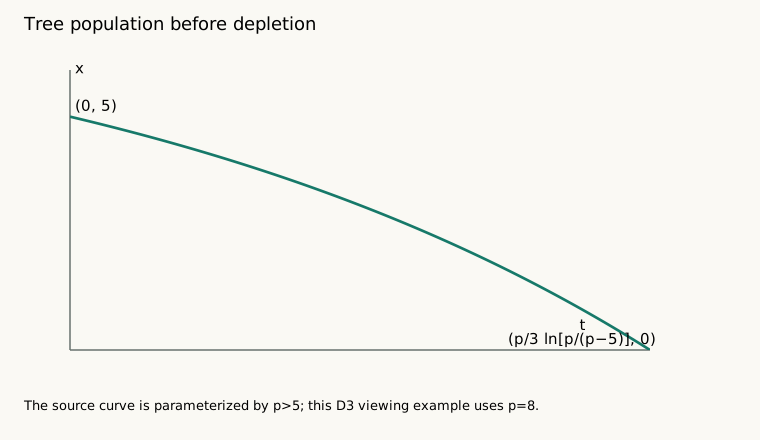
Answer · (iii)
; extinction at .
Population interpretation only .
Inequality
The coefficient of the growing exponential is negative.
Intercept
Solve for .
Meaning
Restrict the population graph to . At the model gives zero trees: the forest is gone. For the formula gives negative values, which are not populations.
Explore the idea