A declining species and an increasing logistic species
On a mangrove swamp, scientists are investigating the population of mudskippers and crabs. Initially, there are 800 mudskippers and 800 crabs on the mangrove swamp. At time years, the number of mudskippers and crabs are respectively.
(a) For the mudskippers, the scientists discovers that every year, the growth rate is 0.4% of the population size and the death rate is 5 mudskippers per year.
(i) Write down a differential equation relating . mark
(ii) Solve the differential equation in part (i) and determine what happens to the mudskipper population in the future. marks
(b) For the crabs, the scientists propose that are related by the differential equation .
(i) Find the number of crabs in the mangrove swamp when the rate of change of is a maximum. marks
(ii) Find in terms of . Sketch a graph of against . marks
[2021/TJC/Prelim/I/10]
Solution
If this part uses an earlier result, revisit (b)(i) Maximum growth rate or open all working together.
Logistic solution
Find in terms of (with initially) and sketch it.
Hint
.
Partial fractions.
Initially there are 800 crabs: the curve starts at the inflection point.
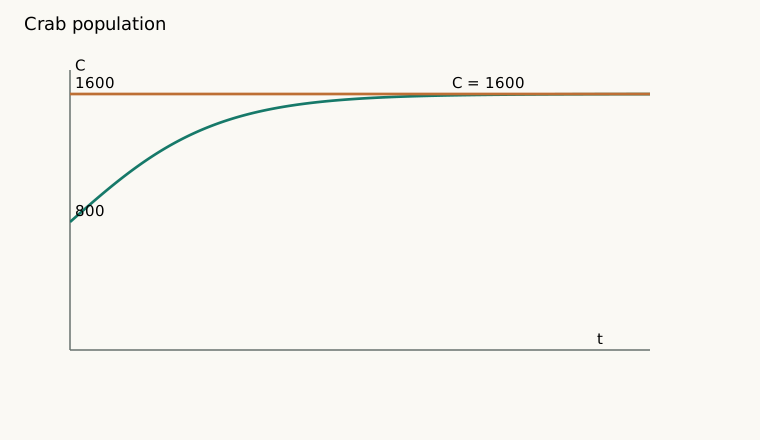
Answer · (b)(ii)
; rises from 800 toward 1600, concave down for .
Separate
Partial fractions give . In , setting (or using cover-up) gives .
Integrate
Integrate.
Solve
; the removed modulus contributes to .
.
Complete-square integration alternative
The difference-of-squares formula gives .
Alternative initial condition
Absorb the modulus sign into . Then gives the same solution.
Result
Rearrange. For , the curve starts at the inflection , increases concavely down for , and approaches 1600 because .
Explore the idea