Quartic roots and an Argand triangle
A, B and C represent complex numbers . These numbers are roots of , where is a quartic polynomial with real coefficients and is complex.
(a) Express as a product of two quadratic factors with real coefficients. marks
(b) Sketch an Argand diagram showing all roots. marks
(c) W represents , with . Find and the area of triangle APW, where P represents . marks
[2024/DHS/Prelim/I/7]
Solution
Real quadratic factors
represent , , , roots of a quartic with real coefficients. Express as a product of two real quadratic factors.
Hint
Find the fourth root by conjugation.
Pair the roots into real quadratics.
The question does not say the quartic is monic, so any non-zero real multiple is allowed.
Answer · (a)
, .
Printed K=1 assumes an unstated monic polynomial.
The fourth root
is non-real, and the coefficients are real, so its conjugate is also a root.
Pair the real roots
Two real roots give one real quadratic.
Pair the conjugates
Sum and product .
Plot the roots
Sketch an Argand diagram showing all the roots.
Hint
Plot , , and .
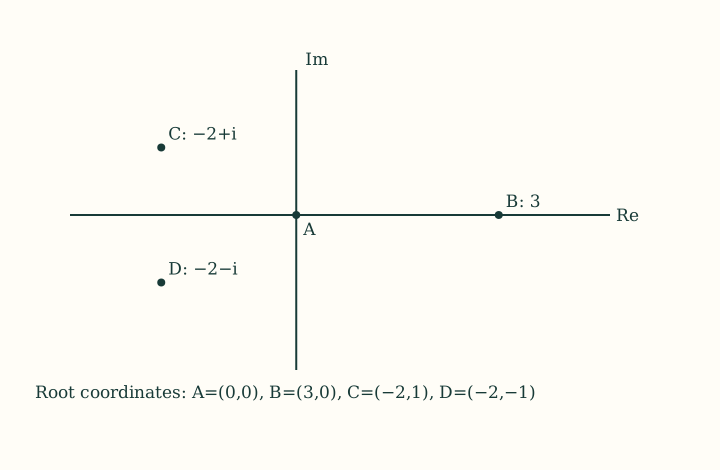
Answer · (b)
Roots at .
Coordinates
The two real roots lie on the horizontal axis. The conjugate pair is symmetric about it.
Explore the idea
Quarter-turn, dot product and area
represents , where , and represents . Find and the area of triangle .
Hint
Solve .
Write the vectors in components and use the dot product and the determinant.
Answer · (c)
; area .
Find
Dividing by is multiplying by : a quarter-turn clockwise.
Dot product
is the origin. The dot product is zero: the vectors are perpendicular, as expected from a quarter-turn.
Area
For two vectors from the origin the triangle area is half the absolute value of the determinant.
Explore the idea
Roots first, geometry second
Conjugation completes the root set, and multiplication by turns vectors through right angles, which makes dot products vanish.