Arguments determine a triangle
, , and . Let W and Z represent respectively.
(i) Use an Argand diagram with reference to origin O to show radians. marks
(ii) Hence or otherwise find . marks
[2020/DHS/Prelim/I/3 modified]
Solution
(i)
Angles from directions
, , and . represent . Use an Argand diagram to show .
Hint
Find the directions of and .
The angle at is the difference of those directions.
Using the wrong direction for
describes , not . Reverse it for the angle at .
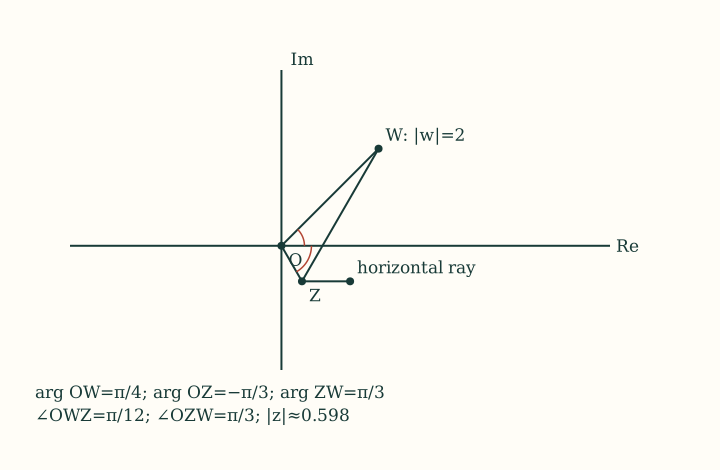
Answer · (i)
; .
Direction of
points at angle , so the reverse points at .
Direction of
is the direction of the vector from to . Reverse it to go from to .
The angle
The angle between two directions is the difference of their angles.
Takeaway
Directions give angles
The argument of a difference is the direction of a side. Angles of a triangle are differences of those directions.