Complex numbers and the Argand plane
Calculate with real and imaginary parts.
← Back to learning units · Complete chapter reading and print view · Open reference notes separately
By the end, you can
- Explain the extension from real to complex numbers
- Find complex roots of quadratic equations
- Use modulus, argument and conjugates
- Perform the four operations with complex numbers
- Use equality of complex numbers
- Use conjugate roots for polynomial equations with real coefficients
- Represent complex numbers on an Argand diagram
- Interpret conjugation, negation, addition, subtraction and multiplication by i geometrically
about 45 minutes for the lesson · practise at your own pace.
The central idea
Complex numbers extend the real numbers with i²=−1. For z=a+bi, its conjugate is a−bi and its modulus is . An argument gives direction in the Argand plane, with the correct quadrant essential. Multiplication adds arguments and multiplies moduli; multiplying by i rotates by π/2 anticlockwise.
The power cycle of i
Define i by . Then , , , ; the cycle repeats every four powers. For positive integers k, and .
The equation has roots . Write a complex number as with real a,b: the real part is a and the imaginary part is b, not ib. For positive real a the principal root is . This does not license multiplying principal roots of arbitrary complex values without checking branches. “Complex” refers to the connected real and imaginary parts.
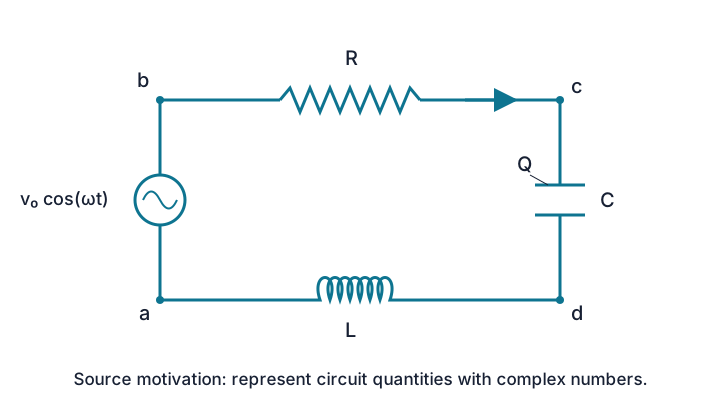
The source circuit motivation
Expand diagramFit diagram to page
Use the scrollbars or arrow keys to inspect details.
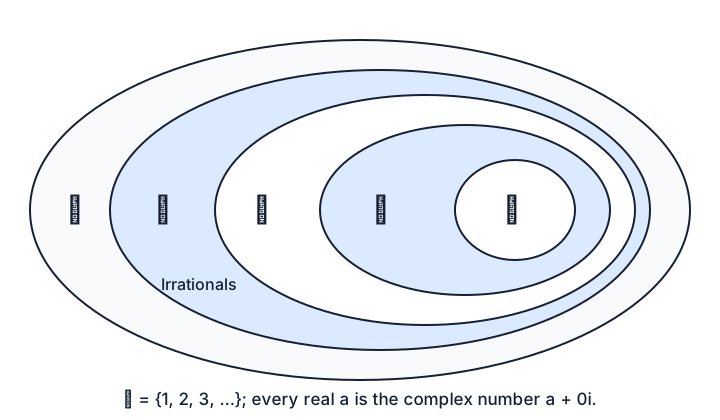
The nested number sets
Read from the smallest set to the largest. Every number in one row also belongs to every row below it. Each next set includes additional numbers.
Natural numbers
Counting numbers . This source starts at 1, so zero is not included in here.
Integers
The counting numbers, their negatives and zero: .
Rational numbers
Numbers , where p and q are integers and . Every integer n is rational because .
Real numbers
Rational and irrational numbers together. Irrationals such as , and are real but not rational; their decimal representations neither terminate nor recur.
Complex numbers
Numbers , with a and b real and . Every real a is also complex: . A complex number need not have a nonzero imaginary part.
Why is each inclusion strict?
A proper subset is contained in a larger set without being equal to it. These examples show what each larger set adds.
Natural numbers are a proper subset of integers
— Zero is an integer, but it is not natural under this source’s convention.
Integers are a proper subset of rational numbers
— One half is rational, but it is not an integer.
Rational numbers are a proper subset of real numbers
— The positive square root of 2 is real and irrational, so it is not rational.
Real numbers are a proper subset of complex numbers
— The imaginary unit is complex but not real: no real number has square −1.
Compare with the nested regions
Expand diagramFit diagram to page
Use the scrollbars or arrow keys to inspect details.
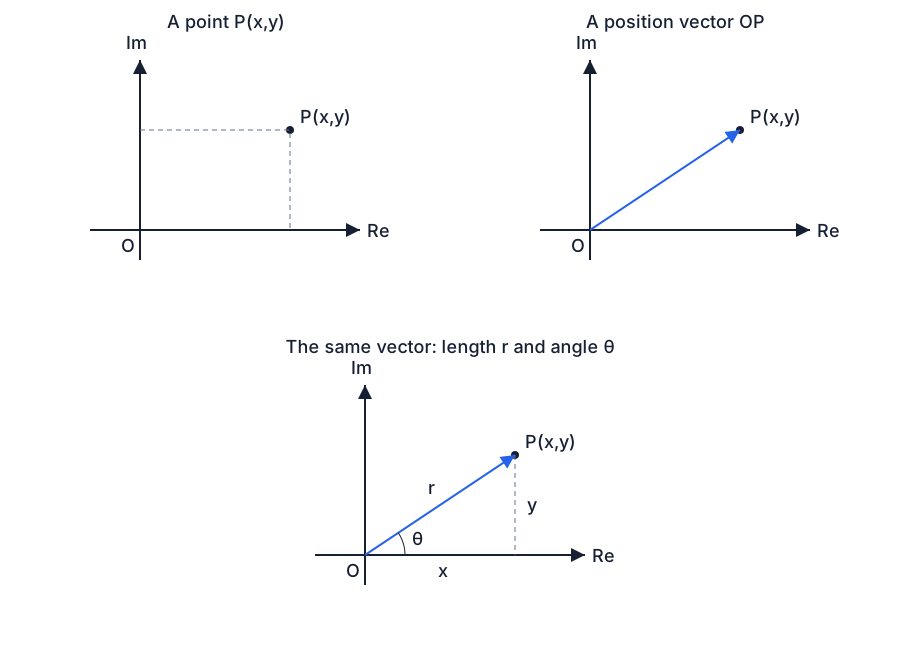
Point, position vector and direction in the Argand plane
Illustration: one complex number as a point and a position vector.
Grid spacing is 1 unit. P = (1, 3). The arrow OP has components (1, 3); its length is |z|.
- Real part x
- 1
- Imaginary part y
- 3
- Modulus |z|
- ≈ 3.1623
- Principal argument θ
- ≈ 1.249 rad
The imaginary part is the real number y, not iy. A point and its position vector describe the same two coordinates.
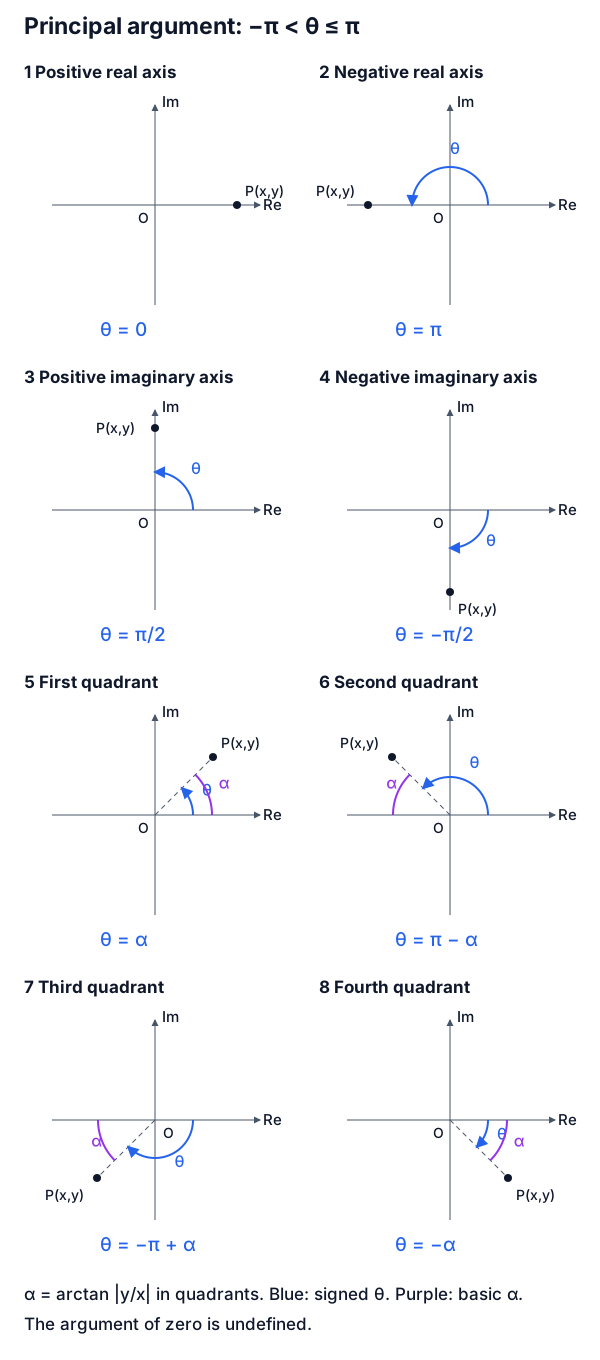
Directions use −π < θ ≤ π, measured from the positive real axis. Anticlockwise is positive; clockwise is negative.
Compare with the three source views
Expand diagramFit diagram to page
Use the scrollbars or arrow keys to inspect details.
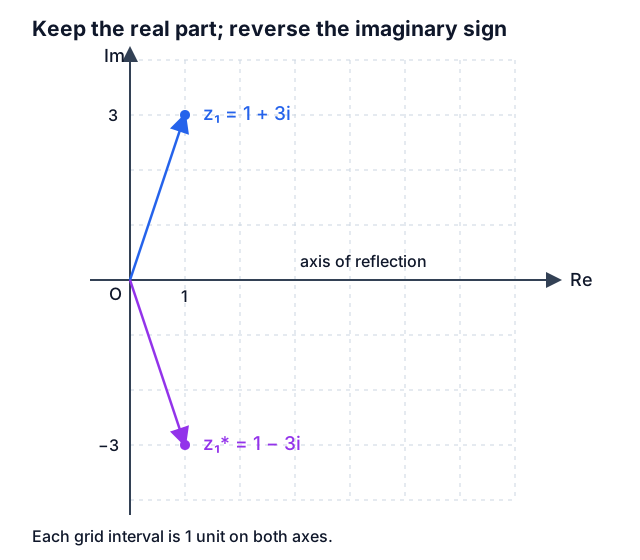
Conjugation reflects in the real axis
Start with the source pair 1 + 3i and 1 − 3i, then change the coordinates.
Grid spacing is 1 unit. Reflection pairs (1, 3) with (1, -3). The two distances from the origin are equal.
- Real part x
- 1
- Imaginary part y
- 3
- Common modulus |z| = |z*|
- ≈ 3.1623
- Principal argument θ
- ≈ 1.249 rad
- Conjugate z*
- 1 − 3i
- Principal argument of z*
- ≈ -1.249 rad
Conjugation keeps the real part and changes the sign of the imaginary part. It reflects the point in the real axis.
Directions use −π < θ ≤ π, measured from the positive real axis. Anticlockwise is positive; clockwise is negative.
Compare with the source reflection
Expand diagramFit diagram to page
Use the scrollbars or arrow keys to inspect details.
Method map: Choose a principal argument
Plot z = x + iy. Check zero, then choose its axis or quadrant. Measure from the positive real axis: anticlockwise is positive; clockwise is negative.
Check that the point has a direction
Write z = x + iy with real x and y. The principal interval here includes π and excludes −π.
- x = 0 and y = 0Stop: zero has no argument
The zero vector has no direction. Its modulus is , but an argument is undefined; cannot supply an angle.
- At least one coordinate is nonzeroChoose the matching position case
If either coordinate is zero, use the axis cases. If both are nonzero, use the quadrant cases. A zero real part does not make the argument undefined when the imaginary part is nonzero.
Keep this interval throughout the calculation. The two directions π and −π reach the same negative real ray, but only π belongs to the chosen principal interval.
Read axis directions directly
Use this stage only for a nonzero point on an axis. One coordinate is zero, so an acute reference triangle is unnecessary.
or
- Positive real · x > 0, y = 0No turn
- Negative real · x < 0, y = 0Half a turn anticlockwise
Use , not the excluded endpoint .
- Positive imaginary · x = 0, y > 0Quarter turn anticlockwise
- Negative imaginary · x = 0, y < 0Quarter turn clockwise
Do not divide by x for a point on the imaginary axis. Its direction is read geometrically even though y/x is undefined.
Use the basic angle and both coordinate signs
Use this stage only when both coordinates are nonzero. Calculate the positive acute basic angle α in radians, then match the quadrant.
- I · x > 0, y > 0Use the basic angle
- II · x < 0, y > 0Subtract from π
- III · x < 0, y < 0Start at −π and add the basic angle
- IV · x > 0, y < 0Use the negative basic angle
The ratio alone cannot distinguish opposite quadrants. Check both signs on the sketch and confirm . Other arguments differ by for an integer k; select the representative in the stated interval.
Try a worked example
Read a case, make a prediction, then reveal the reasoning. The examples keep their stated values.
A negative real number uses the included endpoint
In Example 15(b), . Find its modulus and choose its principal argument.
Show reasoning
1. Locate the nonzero point
The point (−3, 0) is on the negative real axis. It is not the origin, so it has a direction.
2. Separate distance from direction
The squared coordinates sum to 9, so the distance is 3. The principal direction uses the included endpoint π.
3. Check the endpoint
A clockwise half-turn gives −π, which reaches the same ray but is excluded from this principal interval. A zero imaginary part does not imply zero argument.
Equal negative coordinates do not give a first-quadrant angle
In Example 15(h), . Find its modulus and choose its principal argument.
Show reasoning
1. Use both signs before the quotient
The point (−1, −1) lies in quadrant III. Its y/x ratio is positive, just as in quadrant I, so the quotient alone cannot select the direction.
2. Calculate the acute basic angle
The absolute ratio gives the acute angle to the nearest horizontal ray, not the final principal argument.
3. Choose the clockwise principal direction
Quadrant III requires a negative angle in the chosen interval. The positive turn 5π/4 reaches the same ray but is outside it.
Compare with the eight Argand positions
Expand diagramFit diagram to page
Use the scrollbars or arrow keys to inspect details.
Explore
Use the worked example below, then change one input or assumption. Predict which part of the answer must change before calculating.
Related interactive example
Explore this related example, then return to the prediction task above.
Worked example
becomes . The numerator has modulus and argument ; the denominator has the same modulus and argument , so the quotient has modulus and argument .
An inverse tangent value alone may select the wrong quadrant.
Check your understanding
Find the modulus and principal argument of using the interval .
The modulus is and the principal argument is .
Mastery learning objectives
At the end of this chapter, I should be able to:
Choose a practice question
| Common question type | Lecture examples | Discussion questions | Review problems (follow up) |
|---|---|---|---|
| Equality of complex numbers | 1,3,4,13,14 | 1,2 | 1,6,7 |
| Solve an equation involving a complex number | 6 | 3,5,6 | 9(b),10,16,17(a) |
| Solve simultaneous complex equations | 8,9 | 4 | 3,9(a),11 |
| Solve polynomial equations | 10,11,12 | 7,8 | 4,5,8,12,13 |
| Sketch on an Argand diagram and/or describe geometrical effects | 2,16 | 9 | 14 |
| Determine modulus and argument | 15 | 10,11 | 15,17(b) |
Practice questions
Practice section 1 · Questions 1–6
Explain why the new quadratic roots are not real · Relate real numbers to complex numbers · +4 more
- Explain why the new quadratic roots are not real
- Relate real numbers to complex numbers
- Complete the real and imaginary parts table
- Compare real and imaginary components to find two real unknowns
- Plot six complex operations and explain their geometry
- Practise three operations for each of three complex pairs
Practice section 2 · Questions 7–12
Find paired real unknowns by comparing components · Practise comparing components with real parameters · +4 more
Practice section 3 · Questions 13–18
Recall rationalisation before complex division · Divide exactly and identify real and imaginary parts · +4 more
- Recall rationalisation before complex division
- Divide exactly and identify real and imaginary parts
- Practise exact division and combine complex fractions
- Solve simultaneous equations without a graphing calculator
- Use a known complex root to recover and factor a cubic
- Verify a quartic root and find the other roots
Practice section 4 · Questions 19–24
Recover a quartic and deduce reciprocal roots · Reuse a cube after multiplying by i · +4 more
Practice section 5 · Questions 25–30
Sketch complex sums and prove a square · Apply the nine modulus and argument rules · +4 more
Practice section 6 · Questions 31–36
Real coefficients and a known complex root · A quadratic with complex coefficients · +4 more
Practice section 7 · Questions 37–42
Real parts, imaginary parts, moduli and arguments · Use both conjugate constraints to determine z · +4 more
- Real parts, imaginary parts, moduli and arguments
- Use both conjugate constraints to determine z
- Divide exactly using the conjugate of a surd denominator
- Solve coupled equations involving a conjugate
- Use conjugate roots and a reciprocal substitution
- Recover a quartic and reuse its real roots for intersections
Practice section 8 · Questions 43–48
Reuse a known square after multiplying by i · Reuse a square root before undoing a scale and translation · +4 more
- Reuse a known square after multiplying by i
- Reuse a square root before undoing a scale and translation
- Read cubic roots and rotate roots of a complex quadratic
- Distinguish a modulus square from a complex square
- Evaluate a complex quadratic discriminant exactly
- Solve coupled equations by three algebraic methods
Practice section 9 · Questions 49–54
Use a purely imaginary root to factor and transform a quartic · Use rotation to find area and real quadratic factors · +4 more
- Use a purely imaginary root to factor and transform a quartic
- Use rotation to find area and real quadratic factors
- Plot polar points and interpret a complex multiplier
- Find an exact quotient modulus without a calculator
- Solve a conjugate equation without assuming conjugate roots
- Factor a cubic and choose exact principal arguments
More practice
Ready to try this on your own?
For “Complex numbers and the Argand plane”, try a question without the working and explain your method. This records your confidence, saved in this browser only.