Can one function feed another?
Follow the order of a composite, check every intermediate output, and map the final range.
← Back to lesson · Complete chapter reading and print view
By the end, you can
- Read composition from right to left
- Check whether the first range fits inside the second domain
- Find the composite domain and range
about 20 minutes for the lesson · practise at your own pace.
The central idea
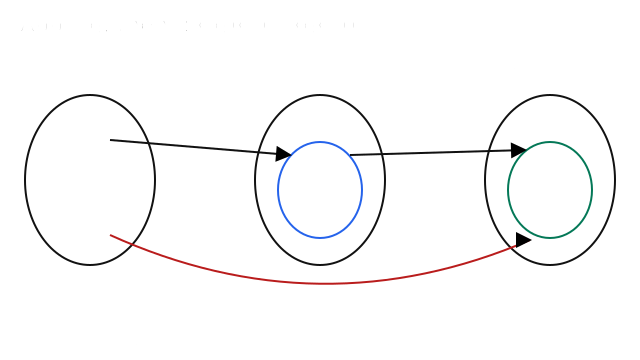
In , apply first, then pass its output to . This works on the entire original domain of only when . If even one output is outside the next function’s domain, the composite does not exist on that whole domain. A restriction can define a different composite, but must be stated explicitly.
Composition maps into reached subsets
Expand diagramFit diagram to page
Use the scrollbars or arrow keys to inspect details.
Explore
Here f takes x to 1 − x², then g takes that intermediate output to its square root plus 2. Move x from one endpoint to the other and watch the intermediate value and final point.
Worked example
For on , . With on , every intermediate value is allowed. Thus , with domain and range . In the opposite order, does not fit inside , so does not exist on the given domain of .
Substitution gives a candidate formula; it does not establish that the composite exists on the printed domain.
Check your understanding
Let on and on . Decide whether and exist on their stated domains. Justify each decision using the entire inner range, and give the rule, domain and range of any composite that exists.
For , is not contained in , so does not exist on the stated domain of . For , , so exists. Its rule is , with domain and range .
Practice questions
Practice section 1 · Questions 1–6
Follow the order and the reached range · Identity rules can have different domains · +4 more
Practice section 2 · Questions 7–9
A piecewise inverse and two identity domains · Check whole-domain composition before finding its range · +1 more
More practice
Use the range/domain check on these questions, then work through their existing interactive solutions.
- When can two functions compose?Show that the composite exists before finding its rule.Open question and interactive solution →
- Map the whole interval, not only its endpointsFollow a whole input interval through two functions.Open question and interactive solution →
- Absolute values and the correct inverse branchKeep restrictions when composing with an inverse.Open question and interactive solution →
Ready to try this on your own?
For “Can one function feed another?”, try a question without the working and explain your method. This records your confidence, saved in this browser only.