Parametric equations
Trace parametric curves, retain their ranges, and solve tangent, normal and locus problems.
← Back to lesson · Complete chapter reading and print view
By the end, you can
- Describe a curve using a shared parameter
- Convert between parametric and Cartesian forms
- Find gradients, tangents and normals
about 20 minutes for the lesson · practise at your own pace.
The central idea
With and , one parameter selects both coordinates. Eliminating t describes the curve, but can lose the direction of travel or parameter restrictions. Where dx/dt is nonzero, . A second derivative requires differentiating this ratio with respect to t and dividing by dx/dt again.
Eliminate the parameter, preserve the path
For and :
| t | -2 | -1 | 0 | 1 | 2 | 3 | 4 |
|---|---|---|---|---|---|---|---|
| x | 8 | 3 | 0 | -1 | 0 | 3 | 8 |
| y | -1 | 0 | 1 | 2 | 3 | 4 | 5 |
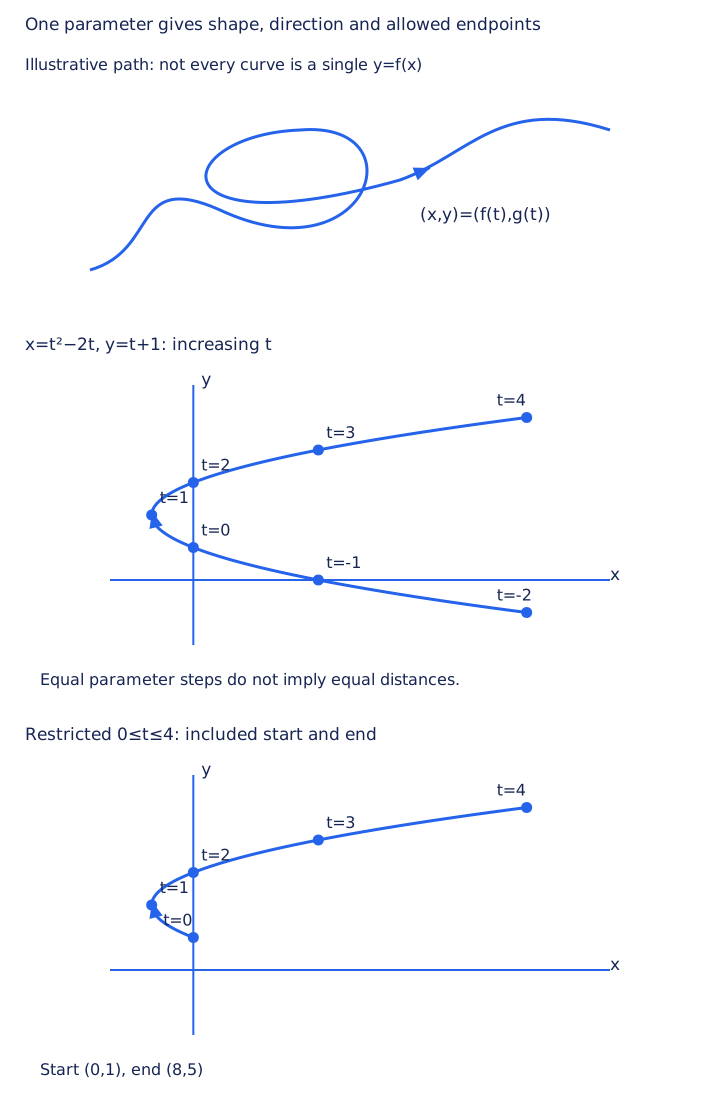
Eliminate t using : . Unrestricted real t traces the parabola. Restricting gives , starting at and ending at , in increasing-t order.
Equal t steps need not mean equal distances; this particle slows towards t=1 and speeds up afterwards. In general on starts at and ends at . Keep direction and restrictions after eliminating t.
A parameter preserves direction as well as shape
Expand diagramFit diagram to page
Use the scrollbars or arrow keys to inspect details.
Explore
Use the worked example below, then change one input or assumption. Predict which part of the answer must change before calculating.
Related interactive example
Explore this related example, then return to the prediction task above.
Worked example
For and with , . At , the point is and the slope is ; the tangent is .
Using dy/dt as the Cartesian slope ignores how fast x also changes.
Check your understanding
For , and , give the Cartesian path with its restrictions and direction. Find the gradient at . Explain why the equation alone is insufficient.
The path is with (so ), moving from to as increases. Since for , the gradient at is . The unrestricted equation includes the upper branch and points beyond the permitted interval.
Mastery learning objectives
At the end of this chapter, I should be able to:
Choose a practice question
| Common question type | Lecture examples | Discussion | Review follow-up |
|---|---|---|---|
| Sketch parametric curve | 2, 3, 4, 6 | 1, 2, 8(ii) | 2, 3(b), 6(ii), 8(i) |
| Convert parametric to Cartesian form | 4, 5, 6 | 2, 3 | 1, 3(a) |
| Find dy/dx using the chain rule | 8 | 5, 8(i) | 4, 5 |
| Find tangent and normal equations | 9, 10, 11 | 4, 6, 7, 8(iii) | 6(i), 7, 8(ii), 9, 10 |
The printed sketch row cites Review 8(i), which asks for a normal rather than a sketch; the original reference is retained here. Review 9(i) explicitly asks for the same quarter-curve sketch as lecture Example 2(b). Review 8(ii) is listed under tangent/normal work and remains a vertical-tangent special case. All full questions are retained in their canonical records.
Practice questions
Practice section 1 · Questions 1–6
Find axial intercepts using the appropriate coordinate · Sketch two parameterised curves with their full allowed ranges · +4 more
- Find axial intercepts using the appropriate coordinate
- Sketch two parameterised curves with their full allowed ranges
- Sketch a scaled rational curve and verify its asymptote
- Retain the positive branch when eliminating a radical parameter
- Eliminate trigonometric parameters to identify an ellipse
- Eliminate reciprocal parameters and retain both hyperbola branches
Practice section 2 · Questions 7–12
Synchronise projectile flight with an approaching target · Divide parameter derivatives to obtain the Cartesian gradient · +4 more
- Synchronise projectile flight with an approaching target
- Divide parameter derivatives to obtain the Cartesian gradient
- Practise reciprocal and trigonometric derivative ratios
- Find tangent and normal equations with a scale parameter
- Trace a moving midpoint locus from tangent intercepts
- Find a normal and distinguish its second curve intersection
Practice section 3 · Questions 13–18
Find all axial intersections of a parametric curve · Eliminate a reciprocal parameter and sketch the hyperbola · +4 more
- Find all axial intersections of a parametric curve
- Eliminate a reciprocal parameter and sketch the hyperbola
- Eliminate exponential and trigonometric parameters
- Find a tangent, normal and exact triangle area
- Differentiate a restricted parametric curve and find an intersection
- Find the locus of a tangent-segment midpoint
Practice section 4 · Questions 19–24
Test whether a tangent meets the curve again · Sketch a cycloid and locate a normal intercept · +4 more
- Test whether a tangent meets the curve again
- Sketch a cycloid and locate a normal intercept
- Eliminate t using a cancelling linear combination
- Eliminate a positive parameter and retain closed endpoints
- Keep the trigonometric range and solve an intersection exactly
- Differentiate a rational and logarithmic parametrisation
Practice section 5 · Questions 25–30
Solve the exact parameter values for a prescribed gradient · Separate a vertical tangent from an excluded endpoint · +4 more
- Solve the exact parameter values for a prescribed gradient
- Separate a vertical tangent from an excluded endpoint
- Derive an ellipse tangent without losing its vertical cases
- Use a horizontal normal to identify a vertical tangent
- Obtain a tangent-intercept triangle and qualify its endpoint
- Remove the original intersection before using a discriminant
Practice section 6 · Question 31
Recover a hyperbola from tangent-intercept midpoints
More practice
Ready to try this on your own?
For “Parametric equations”, try a question without the working and explain your method. This records your confidence, saved in this browser only.