Read a derivative and a reciprocal from a shifted graph
(a) A curve is transformed by a stretch with scale factor 2 parallel to the -axis, followed by a reflection about the -axis. The equation of the resultant curve is , where and . Find and sketch the graph of . marks
(b) The diagram shows the graph of . The graph passes through the origin and has a turning point . The asymptotes of the graph are and .
On separate diagram, sketch the following graphs indicating the points corresponding to the axial intercepts, turning point and asymptotes, where necessary.
(i) marks
(ii) marks
(iii) marks
[modified 2015/RVHS/Prelim/I/10]
Solution
Inverting transformations
A curve is transformed by a stretch with scale factor 2 parallel to the -axis, followed by a reflection in the -axis. The resulting curve has equation , where and . Find and sketch .
Hint
Apply the two transformations to in order and equate with the given curve.
Simplify the logarithm: .
Sketch : asymptote at , intercepts at and .
To find you must undo the reflection first, then the stretch. Equivalently, write the forward transformation and equate.
needs , so the graph exists only for .
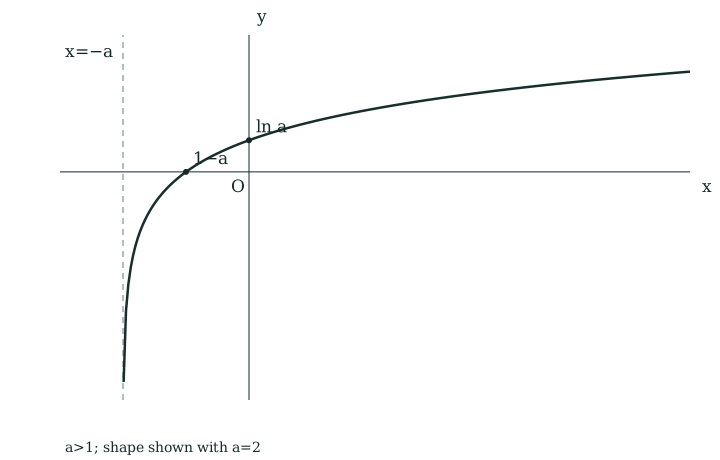
Answer · (a)
; intercepts ; asymptote .
, a>1.
Apply the transformations
A stretch of factor 2 parallel to the -axis doubles . The reflection negates it.
Equate and simplify
.
Solve for
Divide both sides by .
Features of the sketch
at . At , , positive because .
Explore the idea
Translations
The graph of passes through the origin and has a turning point . Its asymptotes are and . Sketch , indicating the points corresponding to the axial intercepts and the turning point, and the asymptotes.
Hint
is shifted left by 1. To recover , shift the given graph right by 1.
Apply the shift to every point and every asymptote.
is the given graph moved right by 1, since the given graph is .
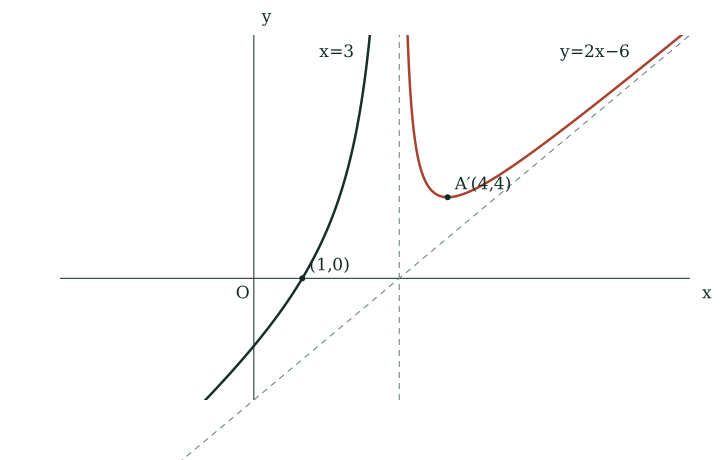
Answer · (b)i
Intercept , minimum ; asymptotes .
Undo the translation
Translate 1 unit in the positive -direction.
Move the features
Add 1 to every -coordinate. For the slanted asymptote, replace by : .
Explore the idea
Sketching the derivative
Sketch the graph of , indicating the points corresponding to the axial intercepts and the turning point, and the asymptotes.
Hint
The derivative is the gradient: trace the gradient of as increases.
A turning point of becomes a zero of .
A vertical asymptote stays; a slanted asymptote of gradient 2 becomes a horizontal asymptote .
On the point does not appear. The turning point becomes the -intercept .
is decreasing on , so there. The graph of must dip below the axis between and .
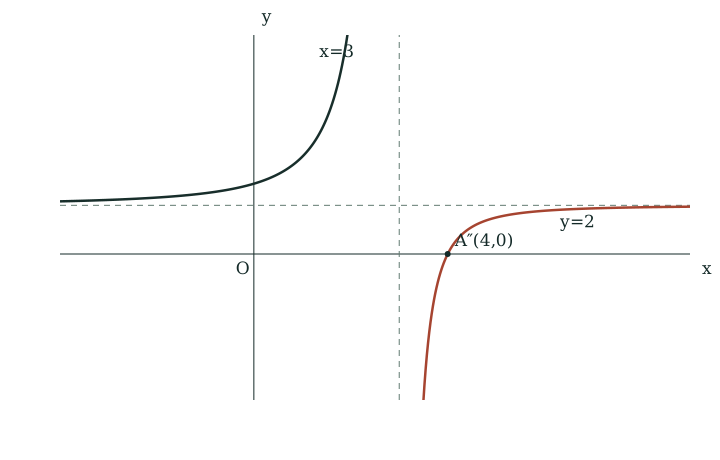
Answer · (b)ii
Zero ; asymptotes .
Positive for x<3 and x>4; negative for 3<x<4. Numerical y-intercept unspecified.
Turning point → zero
At the minimum the gradient is zero, so has an -intercept at .
Asymptotes
For the specific source sketch, the gradients approach the slope 2 of the slanted asymptote. An oblique asymptote alone does not guarantee this for every differentiable function. So as .
Trace the gradient
On the left branch gets steeper as it approaches . On the right branch it starts falling steeply, flattens at the minimum, and then climbs with gradient approaching 2 from below.
Explore the idea
Reciprocal graphs
Sketch the graph of , indicating the points corresponding to the turning point and the asymptotes.
Hint
Zeros of become vertical asymptotes of .
The minimum becomes a maximum .
Large gives , so is a horizontal asymptote.
is undefined, so is too. The curve approaches but never touches it.
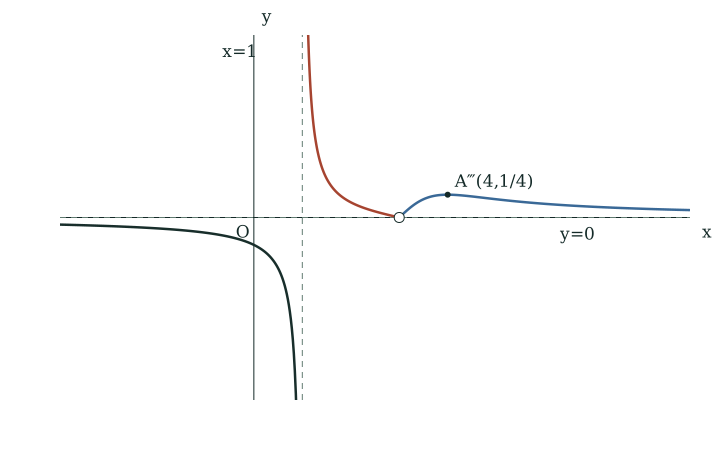
Answer · (b)iii
Maximum ; pole ; hole ; horizontal asymptote .
Zero → vertical asymptote
blows up where .
Turning point inverts
On each interval where is nonzero, and have the same sign, while increasing and decreasing behavior is reversed. In particular, this positive minimum becomes a maximum.
Old asymptotes
The point is approached but not reached because is undefined at : draw an open circle there. The -axis is the horizontal asymptote.
Explore the idea