Compare a rational branch to the upper hyperbola
The curve has equation , where are real constants such that .
(i) By using differentiation, find the range of values of in terms of such that has no stationary points. marks
(ii) Given that , sketch , stating the equations of any asymptotes and the coordinates of the points where crosses the axes. marks
(iii) On the same diagram as , sketch the graph of , showing clearly the equations of the asymptotes and turning points. Hence solve the inequality . marks
[2018/AJC/Prelim/II/3]
Solution
Stationary points
The curve has equation , where , and . By differentiation, find the range of values of in terms of such that has no stationary points.
Hint
Differentiate and set .
Isolate : a square is never negative.
No stationary points means the equation has no real solution.
is given, so dividing is safe. If could be negative the inequality would reverse.
The question excludes (the fraction would vanish and the curve would be a straight line).
Answer · (i)
.
Differentiate
Differentiate to get .
Set to zero
Multiply through by .
No real solution
Since and , the left side is strictly positive. The given excludes a zero right side, so no solution occurs exactly when . Equivalently, expanding gives , whose discriminant is ; requiring it to be negative gives the same condition.
Curve sketching
Given that , sketch , stating the equations of any asymptotes and the coordinates of the points where crosses the axes.
Hint
Substitute and simplify.
Intercepts: and .
Is the curve increasing? Check from (i): holds.
Part (i) already showed there are none when .
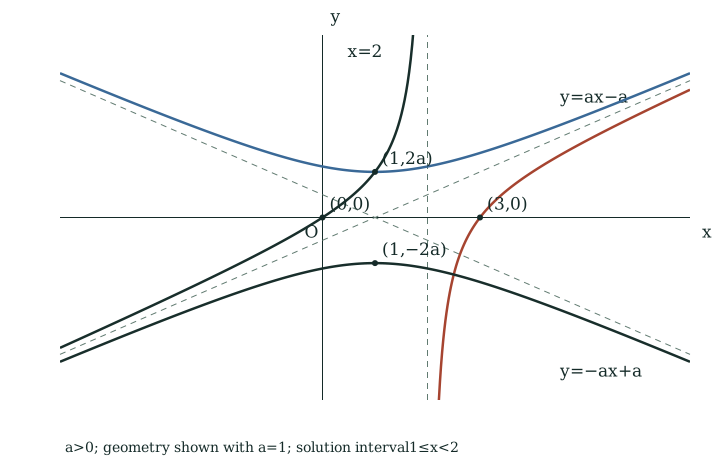
Answer · (ii)
Intercepts ; asymptotes ; increasing on each branch.
.
Simplify
, so and .
Asymptotes
The vertical asymptote is where ; the oblique one is the polynomial part.
Intercepts
Multiplying by gives . The curve crosses the axes at and .
Shape
Since , part (i) says there are no stationary points: each branch is monotonic. , so both branches rise.
Explore the idea
Hyperbolas
On the same diagram as , sketch the graph of , showing clearly the equations of the asymptotes and the turning points.
Hint
Write it as : a hyperbola opening up and down.
Asymptotes: set the right side to 0. Vertices: put .
The term is positive, so the branches open up and down.
Answer · (iii)a
Vertices ; asymptotes .
Standard form
Divide by 4: .
Asymptotes
Replace the 1 by 0 and solve.
Vertices
These are the turning points of each branch.
Explore the idea
Inequalities from graphs
Hence solve the inequality .
Hint
Multiply both sides by : the left side becomes the curve and the right side becomes the upper branch of the hyperbola.
Find where lies on or above the upper branch.
Remember the domain: .
Squaring is only safe when both sides are non-negative. Compare with the graph instead of squaring blindly.
The square root is non-negative, so it corresponds to the upper branch only.
Answer · (iii)b
.
Match the curves
, so multiplying by keeps the direction. is the upper half of , because the square root is positive.
Read the graph
Between (where the curves meet) and the asymptote , shoots up to above the upper branch. Beyond it starts at and stays below the hyperbola; for it is below as well.
Exclude the pole
At the left side is undefined, so is not included.
Explore the idea