A discriminant reveals a forbidden output interval
The curve has equation . It is given that has a vertical asymptote .
(i) Determine the value of . mark
(ii) Find the equation of the other asymptote of . marks
(iii) Prove, using an algebraic method, that cannot lie between , , where is to be determined. marks
(iv) When , the graph of cuts the -axis at 2 distinct points where is a positive integer.
(a) Sketch the graph of when , indicating clearly all asymptotes and the coordinates of the axial intercepts. marks
(b) Deduce the least possible integer value of . mark
[2009/NYJC/Prelim/I/7]
Solution
Asymptotes
The curve has equation . It is given that has a vertical asymptote . Determine the value of .
Hint
A vertical asymptote is where the denominator vanishes.
Set the bracket to zero at ; that gives .
Answer · (i)
.
Denominator zero at
The denominator is .
Oblique asymptotes
Find the equation of the other asymptote of .
Hint
With , . Divide each term by .
The numerator has higher degree than the denominator, so the long-run behaviour is a slanted line.
Answer · (ii)
.
Split the fraction
Divide numerator terms by separately.
Read the oblique asymptote
For large the term vanishes, leaving .
Range by discriminant
Prove, using an algebraic method, that cannot lie between , where is to be determined.
Hint
Let be a value the curve takes. Then must have a real solution .
Rearrange into a quadratic in . A real solution exists only if the discriminant is .
The heights with discriminant are the ones the curve never reaches.
The question prints , but a real square root needs . The working gives , which is positive; the printed sign condition is inconsistent.
We multiplied by , so is excluded; but with the equation gives , which is false, so no extra root arises.
Answer · (iii)
; excluded outputs .
Printed a<0 is inconsistent; the real square-root answer requires a>0.
Form a quadratic in
Fix a horizontal level : a point of intersection with the curve exists exactly when this equation has a real . Multiply by and rearrange; levels with no intersection are precisely the forbidden outputs.
Discriminant
with , , .
No real when the discriminant is negative
gives . For these the equation has no real , so the curve cannot take those values.
Match the form
Comparing with .
Explore the idea
Curve sketching
When , the graph of cuts the -axis at 2 distinct points, where is a positive integer. Sketch the graph, indicating clearly all asymptotes and the coordinates of the axial intercepts.
Hint
With : . Divide to find the oblique asymptote.
-intercept: put . -intercepts: solve the quadratic.
Draw the two branches around .
Adding moves everything, asymptotes included, up by .
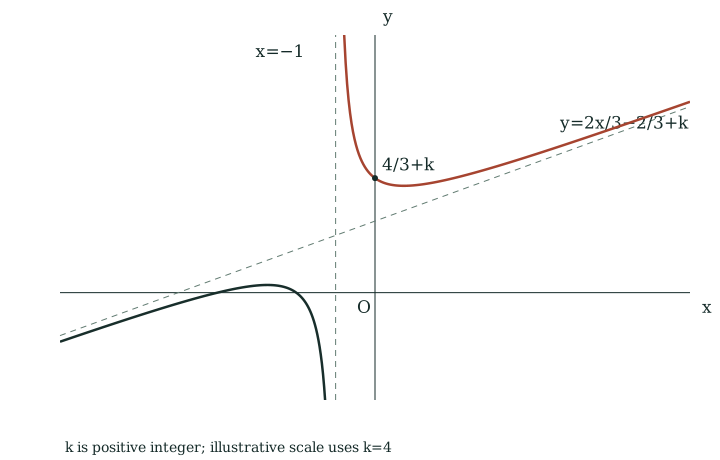
Answer · (iv)a
Asymptotes ; y-intercept ; x-intercepts .
Representative diagram uses k=4.
Divide
.
Asymptotes
The fraction vanishes for large .
Intercepts
gives . Setting gives , whose roots are the stated values.
Explore the idea
Integer thresholds
Deduce the least possible integer value of .
Hint
Two distinct -intercepts means has two distinct real roots.
Positive discriminant, then the least integer .
rounds to 4 here, but only because we need the least integer that works, and fails.
Answer · (iv)b
.
Discriminant
is the equation multiplied out.
Solve
The positive root of is . For positive we need .
Least integer
gives discriminant , and gives .
Explore the idea