Recover a rational curve from its asymptotes
The diagram above shows the graph of the function where , . The oblique asymptote intersects the axes at and . Find the values of .
By considering , show that . marks
Sketch, on a separate diagram, the graph of . marks
[2008/NJC/Prelim/I/11(i)]
Solution
Asymptotes of rational functions
. The graph has vertical asymptote and an oblique asymptote meeting the axes at and . Find , , , and by considering show that .
Hint
The vertical asymptote gives .
Write the oblique asymptote from its intercepts and match .
A graph without turning points has with no real solution.
Keep while solving. The borderline gives only the excluded candidate after rearrangement; it is the visible vertical asymptote, rather than the absence of stationary points alone, that rules this case out.
Answer · Constants
; .
Vertical asymptote
The denominator vanishes at the asymptote.
Oblique asymptote
The line passes through and .
Match the form
Comparing with gives , , .
Differentiate
.
No turning points
The graph has no stationary points, so this equation has no real solution.
Conclude
If , the equation has two nonzero real roots, contradicting the sketch. If , the derivative is the constant , but the vertical asymptote disappears, also contradicting the sketch. Hence . Equivalently, after excluding , the quadratic has no real roots when its discriminant .
Explore the idea
Gradient graphs
Sketch, on a separate diagram, the graph of .
Hint
is always below .
As the fraction vanishes, so ; near it plunges.
, so it is always below .
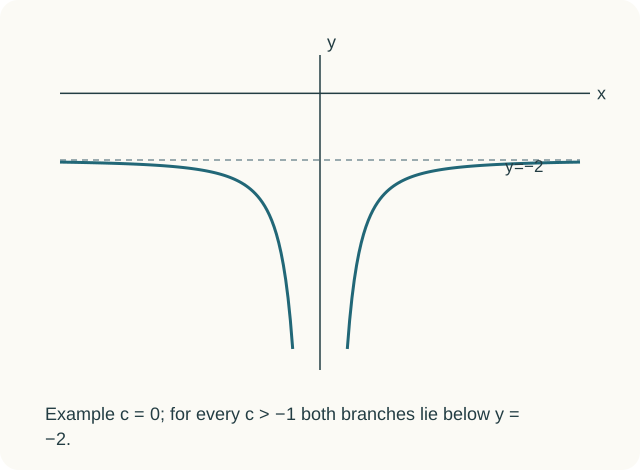
Answer · Derivative sketch
; asymptotes ; both branches below −2.
, c>−1.
The formula
From the previous part.
Bounds
The fraction is positive since .
Asymptotes
Far from 0 the gradient approaches the slope of the oblique asymptote. Near 0 it tends to .
Shape
The graph is symmetric about the -axis, with both branches below .
Explore the idea