Rotate the region between a bell curve and a line
(i) Sketch and on the same diagram, showing clearly the coordinates of the stationary point and intersection points. marks
(ii) Find the exact area of region R enclosed by the curves and . marks
(iii) Find the volume generated when R is rotated about the -axis. marks
[2011/MI/Prelim/II/2]
Solution
Curve sketching
Sketch and on the same diagram. Label the stationary point and the intersection points.
Hint
Where is largest? Look at when the denominator is smallest.
Where does the curve meet ? Solve .
What happens as , and where does the curve cross the -axis?
The question asks for the stationary point and the intersections, so write all three coordinates on the sketch.
Since and , the curve stays strictly above .
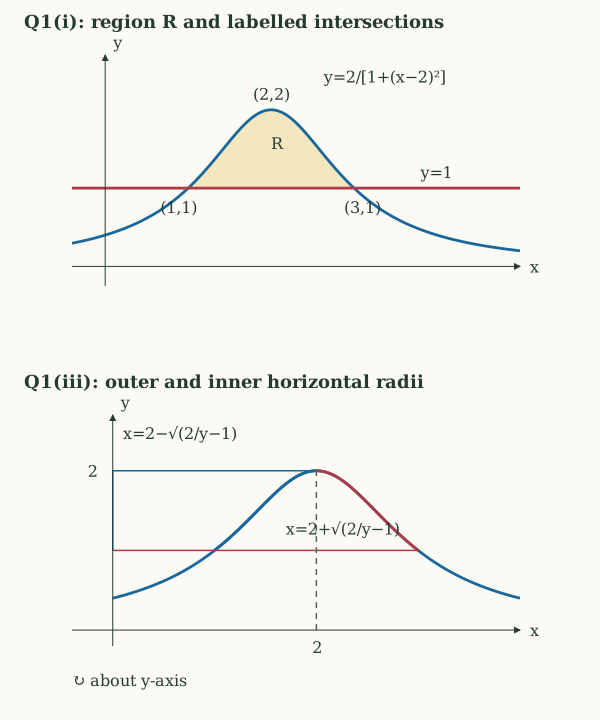
Answer · (i)
Maximum ; intersections ; asymptote .
Find the stationary point
The gradient is positive for and negative for , so is a maximum. You can also see it without calculus: , so the denominator is at least 1 and .
Find where the curves meet
Both intersections have , giving and . They sit symmetrically either side of the peak.
Check the ends and the intercept
The -axis is a horizontal asymptote. Since for every , the curve never touches it.
Draw it
Draw a bell symmetric about that peaks at and flattens towards on both sides. Draw the line across it and label all three points.
Explore the idea
Area between curves
Find the exact area of the region enclosed by the two curves and the lines and .
Hint
Each thin vertical strip of has height (curve) − (line).
Integrate that height from to .
“Exact” means the answer stays in terms of , so look for an arctangent.
Integrating only the curve gives . That measures the area all the way down to the -axis, not .
must be , not . Integration results are always in radians.
Answer · (ii)
Area .
Set up upper minus lower
Between and the curve lies above the line, so each strip has height .
Spot the arctangent
This is the standard result with and .
Substitute the limits
Use and , in radians.
Simplify and sense-check
The strips in the explorer above settle on the same number, which confirms the algebra.
Explore the idea
Volume of revolution
Find the volume generated when is rotated through about the -axis.
Hint
Picture the solid. sits between and , so spinning it about the -axis leaves a hole.
For washers, slice horizontally. Each radius must be written as in terms of .
Outer radius from the right branch, inner radius from the left. Then integrate over .
rotates about the -axis. About the -axis you need .
is wrong because . Subtract the two discs, not the two radii.
Answer · (iii)
Volume cubic units (3 s.f.).
Make x the subject
Rotating about the -axis means horizontal slices, so we need as a function of . The branch is the right edge of (outer radius) and the branch is the left edge (inner radius).
Area of one washer
Outer disc minus inner disc. With , the difference of squares gives .
Integrate over the heights of R
spans heights from the line up to the peak .
Evaluate
A GC value of to 3 s.f. earns the marks. For the exact value, substitute : the integral becomes .
Explore the idea
Connect the parts: area × distance travelled
By the symmetry from (i), the centre of is at . Each turn carries that centre around a circle of length . Multiply by the area from (ii) and you get the volume from (iii):
This is Pappus’s centroid theorem. It is not on the syllabus, but it is a quick independent check of your answer.