Find the region before you choose the radii
Curve C: .
(i) Without a calculator, determine its exact stationary point. marks
(ii) Sketch C, stating clearly any asymptotes. marks
R is bounded by C, and the -axis.
(iii) Find its exact area. marks
(iv) Find the volume when R is rotated radians about the -axis. marks
[2021/EJC/Prelim/II/4]
Solution
If this part uses an earlier result, revisit (i) Stationary points or open all working together.
Curve sketching
Sketch , stating clearly any asymptotes.
Hint
What happens to the fraction as ?
Find the -intercept () and the -intercepts ().
Plot the minimum from (i) and use the symmetry about .
“Stating clearly any asymptotes” earns a mark. Draw it dashed and write beside it.
for every , so the curve never touches .
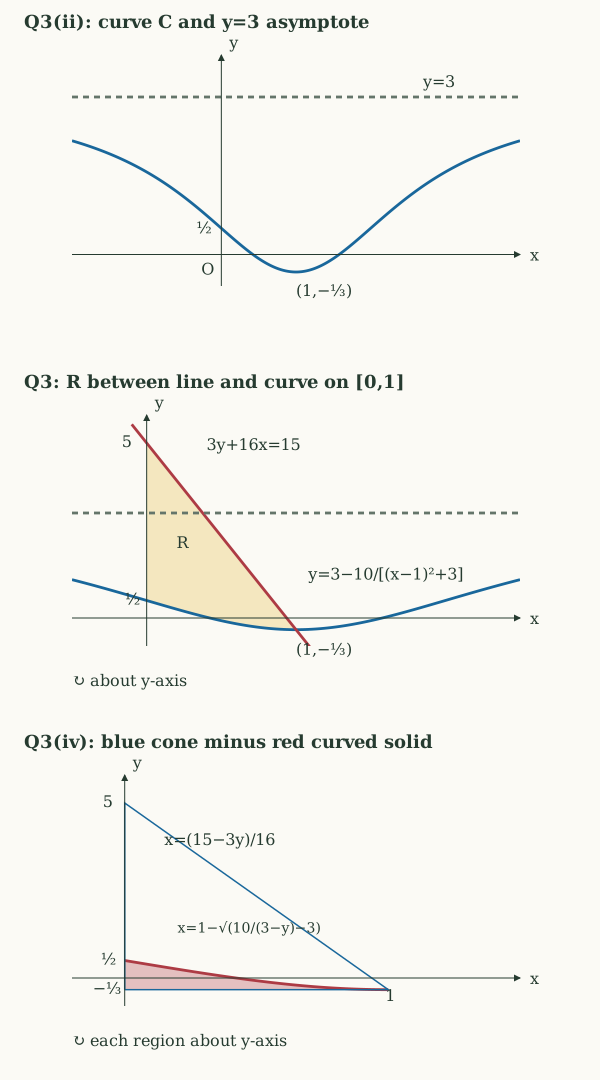
Answer · (ii)
Asymptote ; intercepts .
Asymptote
The curve approaches the horizontal asymptote from below, because the subtracted fraction is always positive.
Intercepts
Setting gives , so and .
Draw it
Draw a shallow bowl with its lowest point at , rising symmetrically towards the dashed line . Label the asymptote, the minimum and the three intercepts.
Explore the idea
Open interactive exploration
Sketch first, then choose radii
The region touches the axis only for . Below that the curve moves away from the axis, which is what creates the hollow. Seeing that on a sketch is what tells you whether you need one integral or a subtraction.