Count roots on either side of a pole
The curve has equation , where is a constant.
(i) Find in terms of , and deduce the range of values of if has two distinct stationary points. marks
(ii) Given that the asymptotes of intersect at the point , show that . marks
(iii) Sketch , indicating clearly the asymptotes and stationary points. marks
(iv) For , find the range of values of , correct to 3 decimal places, such that the equation has exactly one real root. marks
[2011/NJC/Prelim/I/12b]
Solution
Stationary points
The curve has equation , where is a constant. Find in terms of , and deduce the range of values of if has two distinct stationary points.
Hint
Use the quotient rule.
Stationary points are the roots of the numerator of .
Two distinct roots means the discriminant is positive.
It is , not .
The curve is not defined at , so a root there would not count. Check the quadratic has no root at : vanishes only for , which is excluded.
Answer · (i)
; or .
.
Quotient rule
, : over . Expanding, , and subtracting leaves .
Set the numerator to zero
exactly when the numerator is zero (and ).
Discriminant condition
Two distinct real roots need a positive discriminant. If , the numerator equation is , so it has no solution.
Asymptotes
Given that the asymptotes of intersect at the point , show that .
Hint
Divide the numerator by to expose the oblique asymptote.
The asymptotes meet at on the oblique line. Substitute .
is on the asymptote, not on the curve (the curve is undefined at ).
Answer · (ii)
.
Long division
.
Identify the asymptotes
The vertical asymptote is where , and the remaining fraction vanishes for large .
Intersection point
The point lies on the oblique asymptote.
Curve sketching
Sketch , indicating clearly the asymptotes and the stationary points.
Hint
With : .
Stationary points from .
The curve hugs its two asymptotes.
The gradient changes from positive to negative at , giving a maximum, and from negative to positive at , giving a minimum.
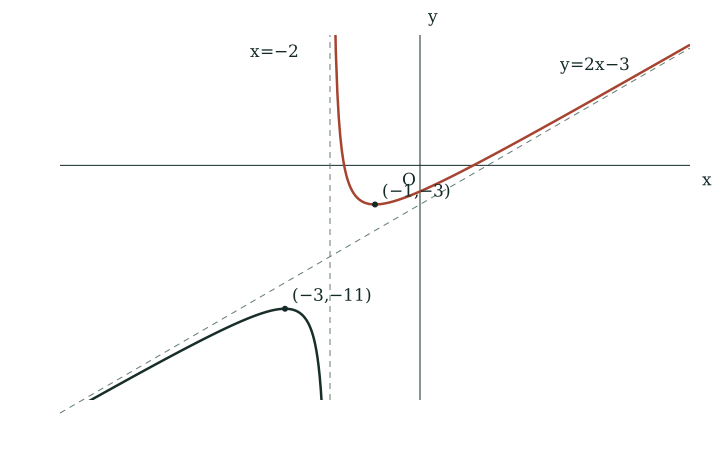
Answer · (iii)
Asymptotes ; maximum , minimum .
Equation of
From (ii) with : and .
Stationary points
At : . At : .
Classify
The branch right of comes down from to the minimum and then rises along . The left branch rises to the maximum and then drops to .
Explore the idea
Roots from two curves
For , find the range of values of , correct to 3 decimal places, such that the equation has exactly one real root.
Hint
Take reciprocals of both sides to compare (the curve with ) with .
Sketch : it exists only for , with an asymptote at .
Use the -intercept of to decide where the single crossing is guaranteed.
The printed solution writes , but the relevant zero is the positive root .
only exists for . Any root must lie to the right of .
Answer · (iv)
(3 d.p.).
Use the exact boundary for decisions near it.
Reciprocal form
Both sides are non-zero for the roots we care about. The left side is exactly .
The reciprocal logarithm
has a vertical asymptote at (where ), tends to as (the point is approached but excluded), is negative on and positive and decreasing for .
Where crosses the -axis
is positive and increasing for (the right branch beyond its minimum). The positive root is the one that matters here.
Exactly one intersection
If then for the curve is positive, so it cannot meet the negative part of the reciprocal log. On the reciprocal log falls from to 0 while rises, so they cross exactly once. For smaller the curve is negative at some points of and extra crossings appear.
Explore the idea