When can two functions compose?
The functions are for , and for , with real inputs.
(i) Sketch y=f(x) and state its range. marks
(ii) Find the inverse of f and its domain. marks
(iii) Show that fg exists. marks
(iv) Find fg(x) and its range. marks
(v) With g now defined on all real numbers, describe fully a sequence of transformations taking y=g(x) to . marks
[2023/MI/Promo/PU2/I/8]
Solution
Range from a graph
The functions are for and for . Sketch and state its range.
Hint
Square-root graph starting where the radicand is zero.
Read the range off the -values of the graph.
The range is about -values (outputs), the domain about -values (inputs).
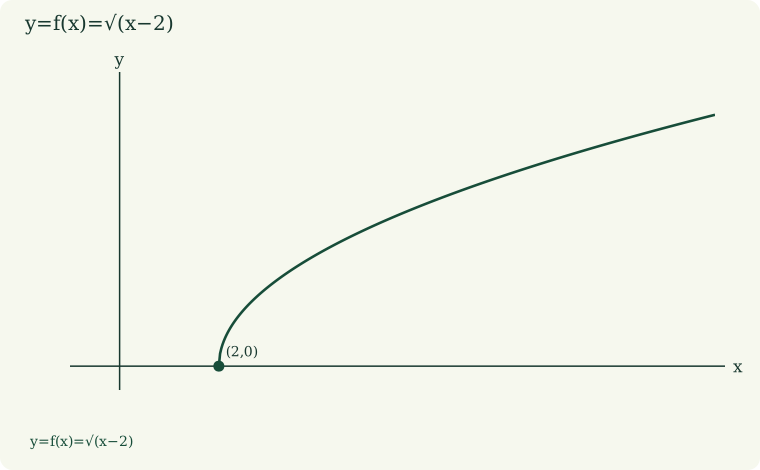
Answer · (i)
; closed start .
Starting point
The curve begins at the closed point .
Shape
For larger the root increases without bound, but slowly. The graph never goes below the -axis.
Range
The -values run from 0 upwards with no upper limit.
Explore the idea
Inverse functions
Find the inverse of and state its domain.
Hint
Write and make the subject.
Swap the names and .
The domain of is the range of .
A function is a rule plus a domain. for all is a different function from .
Answer · (ii)
, .
Make the subject
Squaring is safe because already.
Swap and state the rule
Rename as .
Domain
The inverse accepts exactly the outputs of . Without this restriction, would also accept negative numbers and would not be the inverse.
Explore the idea
Existence of composites
Show that exists.
Hint
exists when .
Find by completing the square and checking the endpoints of the domain.
Compare with .
The condition is about the range of the first function, not its domain.
Answer · (iii)
exists: .
Range of
The minimum is . At the ends: and , which is larger.
Domain of
needs .
Compare
Every output of is an allowed input of .
Explore the idea
Composite rule and range
Find and its range.
Hint
Substitute into .
Simplify the radicand.
For the range, use the range of as the new domain of .
, not . For the latter is negative, which a square root can never be.
Answer · (iv)
, .
.
Compose
and .
Range via
is increasing, so and .
Check with the V-shaped graph
on has vertex and its largest value at : .
Explore the idea
Transformations
With now defined for all real , describe fully a sequence of transformations that takes the graph of to the graph of .
Hint
Complete the square: .
Remove the -translation, then handle the stretch and the vertical shift.
Track the vertex: .
After shifting left 1, scaling vertically by first requires a downward shift of instead of 5. A third sequence is: shift left 1, stretch parallel to the -axis by (replace by ), then shift down 3; the intermediate rules are , and .
moves the graph left.
Answer · (v)
Translate left 1, down 5, then scale vertically by 1/3.
Translate 1 unit left
Replace by . The vertex moves to .
Translate 5 units down
Replace by . The vertex is now .
Scale by parallel to the -axis
Replace by : every height is divided by 3, so the vertex moves to .
Explore the idea