Restrict the domain to choose an inverse
For all real x, .
(i) Find its range. marks
(ii) Explain why it has no inverse. mark
(iii) Restrict its domain to : find the least k that gives an inverse, and find that inverse. marks
(iv) Sketch the restricted f and its inverse together, clearly showing their relationship. marks
(v) Show algebraically that a solution of satisfies . marks
[2011/IJC/Prelim/I/9]
Solution
Range
For all real , . Find its range.
Hint
The denominator is smallest when .
As the fraction tends to 0 but never reaches it.
gets arbitrarily close to 0 but never equals it, so 0 is not in the range.
Answer · (i)
.
Maximum
, so the denominator is at least 1 and .
Lower end
A positive numerator over a positive denominator gives , and the growing denominator makes . Thus the horizontal asymptote is . The printed sketch labels it in error; is the horizontal-line test level.
Explore the idea
One-one functions
Explain why has no inverse.
Hint
Find two different inputs with the same output (horizontal-line test).
Give the counterexample: two specific inputs with the same output.
Answer · (ii)
No inverse: with different inputs.
A counterexample
Both and lie on opposite sides of the axis of symmetry .
Conclusion
The horizontal line meets the graph twice, so is not one-one and has no inverse.
Explore the idea
Restricting a domain
The domain of is restricted to . Find the least for which exists, and find .
Hint
The restricted piece must be monotonic: keep one side of the peak.
Solve for and choose the branch that matches the domain.
State the domain of the inverse.
On , , so the root is added. With the minus sign you would invert the left half instead.
is the inverse function, not the reciprocal .
Answer · (iii)
; , .
Least
To the right of the peak the graph decreases steadily and is one-one. Starting at the peak keeps the maximum.
Solve for
Two branches, from the two sides of the peak.
Choose the branch
We need the plus sign for .
State the inverse
The domain is the range of the restricted : .
Explore the idea
Graph of an inverse
Sketch the restricted and on the same diagram, clearly showing their relationship.
Hint
Use the same scale on both axes.
Draw from downwards, and reflect it in .
Mark the end-points.
If the axes are not to the same scale, the reflection will not look like a reflection.
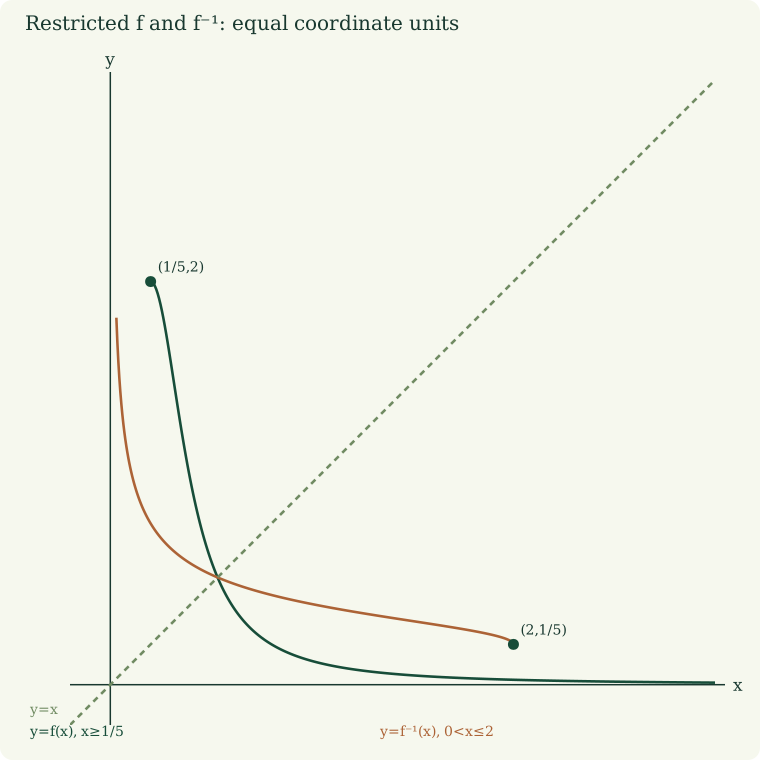
Answer · (iv)
Reflection in ; endpoints .
Equal coordinate-unit scales.
Restricted
The right-hand side of the bell.
Reflect in
Swap each point's coordinates. The horizontal asymptote becomes the vertical asymptote .
Same scale
With equal units on both axes the two curves are visibly mirror images across .
Explore the idea
Fixed points
Show algebraically that a solution of satisfies .
Hint
For a decreasing function the curves and meet on .
So solve .
For decreasing functions, can have off-diagonal two-cycles. The shortcut is valid here only after the domain check above excludes both extra candidates.
Answer · (v)
.
For the restricted function; general decreasing functions can have additional inverse-intersection two-cycles.
Intersection on
Reflection alone does not exclude off-diagonal intersections for a decreasing function. Here an intersection has and , and satisfies . Clearing its positive denominators gives . The quadratic roots are : the smaller is below , and the larger maps to that smaller value, so neither is admissible. Only the fixed-point cubic remains.
Substitute the rule
Clear the denominator
.
Explore the idea